
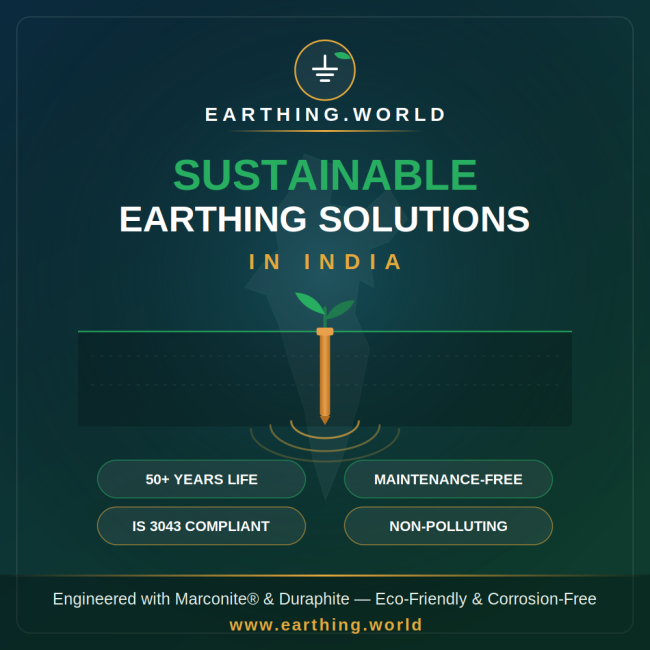
Sustainable Earthing Solutions — Maintenance-Free Grounding That Lasts 50+ Years
Engineered earthing systems built on Marconite® and Duraphite — non-polluting, chemically inert, corrosion-free, and IS 3043 compliant. Lower lifecycle cost, consistent fault dissipation, and electrical safety you can trust across hospitals, data centres, substations, solar plants, and factories.
- 50+ yrs design life
- 0.001 Ωm material resistivity
- Zero re-charging / watering
- IS 3043 · IEC 62561 · IEEE 80 compliant
Why Sustainability Now Matters in Electrical Earthing
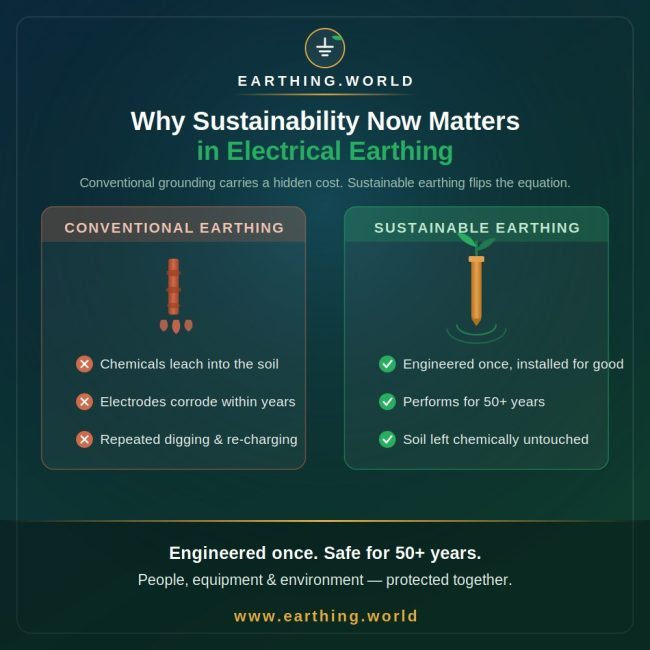
Rising global temperatures and tighter environmental regulation are reshaping every layer of electrical infrastructure — and earthing is no exception. For decades, grounding was treated as a “fit and forget” line item. But conventional earthing carries a hidden environmental and financial cost: chemicals that leach into the soil, electrodes that corrode within a few years, and the repeated digging, re-charging, and re-installation that follows.
Sustainable earthing flips that equation. Instead of degrading over time, the right system is engineered once, performs for half a century, and leaves the surrounding soil chemically untouched — protecting people, equipment, and the environment at the same time.
What People Saying About Our Services
Book an Appointment
Receive an accurate quote within 3-5 days when you fill out the form on this page. Or, give us a call: (+91 72900 43400)
Standards, Testing & Where Our Systems Are Used
Sustainable earthing is only meaningful if it is verifiably compliant and safe. Earthing.World designs to the Indian and international codes that govern earthing practice:
- IS 3043 — Indian Standard Code of Practice for Earthing.
- IEC 62561 (Parts 2 & 7) — lightning protection components & earth-enhancing compounds.
- IEEE 80 & BS 7430 — substation and installation earthing design.
- National Building Code of India 2016 — earthing system guidelines for buildings.
Materials are selected against tested, documented performance criteria for resistivity, corrosion resistance, and mechanical strength — so what is specified on paper is what performs in the ground.
Earthing.World Engineers Sustainable Earthing
At Earthing.World, sustainability is engineered into the material itself — not bolted on as a marketing claim. Our systems are built around two advanced, field-proven earthing media:
Marconite® — conductive aggregate for permanent earthing
Marconite is a granulated, electrically conductive aggregate that replaces sand in a cement mix to form conductive concrete around the electrode. Developed specifically for earthing over several decades, it delivers a permanent, solid mass that does not shrink, dry out, or wash away.
- Very low resistivity (≈ 0.001 Ωm) for efficient fault-current dissipation.
- Chemically inert & neutral pH — non-corrosive to copper, steel, and concrete.
- Permanent & stable — performs from first pour, with a 50+ year life and no re-charging.
- Works in difficult ground — rocky, sandy, and high-resistivity soils where conventional pits fail.
- Non-polluting — does not leach into soil or the groundwater table.
Duraphite — high-carbon graphite earthing compound
Duraphite is a graphite-based earthing compound chosen for its high conductivity, corrosion resistance, and long-term stability. Used within an engineered electrode system, it maintains a low, consistent earth resistance without the recurring chemical treatment that conventional compounds demand — keeping the installation both safe and environmentally responsible across its service life.
Salts – The Engine of Ionic Conduction
Specially formulated conductive salts are blended with Bentonite to enhance ionic conduction. Once dissolved in water, these salts create a conductive medium that allows electrons to travel efficiently through the soil — significantly improving fault current dissipation.
Why Earthing is Critical for Electrical Safety in India
Earthing systems are not optional — they are a legal and life-safety necessity. A properly designed earthing system:
- Prevents electric shocks to people in homes, offices, and factories
- Protects sensitive equipment from damage caused by fault currents and lightning
- Ensures compliance with IS:3043, IS 732, and CEA Regulations
- Reduces downtime in industrial and commercial operations
- Provides peace of mind through certified, reliable installation
Investing in a quality earthing system from Earthing World is an investment in protection, compliance, and long-term performance.
Why Expert Guidance Matters in Choosing an Earthing System
Selecting the right earthing solution is not a one-size-fits-all decision. The ideal system depends on:
- Soil type and resistivity
- Local groundwater conditions
- Application — residential, commercial, or industrial
- Compliance and safety requirements
Unfortunately, many homeowners, businesses, and even industries in India choose earthing systems blindly — based purely on cost — and end up compromising safety. Earthing World’s qualified earthing experts evaluate your site, recommend the best-suited solution (chemical, copper bonded, GI, or hybrid), and ensure compliance with all relevant Indian standards.
Frequently Asked Questions (FAQs) – Sustainable Earthing Solutions India
Sustainable earthing is a grounding system engineered to deliver reliable, low-resistance electrical safety for 50+ years while remaining non-polluting, chemically inert, and maintenance-free — unlike conventional chemical earthing that degrades and can contaminate soil.
A correctly installed Marconite-based system is designed to perform for 50+ years with no re-charging or watering, because the conductive aggregate forms a permanent, stable, non-corrosive mass around the electrode.
The upfront cost can be higher, but the lifecycle cost is lower. A one-time installation that lasts decades avoids the repeated digging, re-charging, and replacement that conventional earthing requires.
Yes. Conductive-aggregate systems are specifically engineered for difficult, high-resistivity ground where traditional salt/charcoal pits struggle to hold a stable low resistance.
Yes. Earthing.World designs to IS 3043 along with IEC 62561, IEEE 80, and BS 7430, and follows the National Building Code of India 2016 guidelines for earthing.
Marconite is chemically inert, has a neutral pH, is non-corrosive, and does not leach into the soil or groundwater — making it an environmentally safe, non-polluting earthing medium.
Engineered for safety-critical environments
Sustainable earthing systems of this class are specified wherever continuity of power and life-safety cannot be compromised:
- Hospitals and DG-set / power-backup installations
- Data centres, IT parks, and telecom towers
- Substations and power transmission & distribution
- Solar plants and renewable-energy installations
- Factories, industrial plants, and defence facilities
Why Choose Earthing.World for Sustainable Earthing
Switching to sustainable earthing is not just about compliance — it is about responsibility, reliability, and long-term value. Choosing Earthing.World means you:
- Cut lifecycle cost with a one-time, 50+ year installation instead of repeated re-digs.
- Protect lives and assets with stable, low-resistance fault and lightning dissipation.
- Reduce environmental impact with non-polluting, chemically inert materials.
- Stay fully compliant with IS 3043 and international earthing standards.
- Build a reputation for innovation and environmental stewardship.
Ready to make the safer, greener choice? Talk to an Earthing.World engineer for a free site assessment and a sustainable earthing design tailored to your soil conditions and load.
What Makes an Earthing System Truly Sustainable?
Not every product marketed as “maintenance-free” is genuinely sustainable. A truly sustainable earthing solution has to satisfy four engineering criteria at once:
- Non-polluting & environmentally safe — no harmful chemicals leaching into soil or groundwater.
- Neutral pH & chemically inert — the backfill must not corrode copper or steel, attack concrete, or react with the soil.
- Long-term reliability — a working design life of at least 50 years with no replacement and stable earth resistance throughout.
- Consistent electrical safety — dependable low-resistance fault dissipation, even in difficult rocky, sandy, or high-resistivity soils.
Conventional vs Sustainable Earthing — at a glance
| Factor | Conventional / Chemical Earthing | Sustainable Earthing (Marconite + Duraphite) |
|---|---|---|
| Design life | Often a few years | 50+ years, no replacement |
| Maintenance | Periodic watering / chemical top-up | Zero — no re-charging required |
| Soil impact | Can leach chemicals, shift pH | Non-polluting, neutral pH, inert |
| Corrosion | Electrodes corrode over time | Chemically inert, non-corrosive |
| Resistance over time | Drifts upward as it degrades | Stable, consistent low resistance |
| Difficult soil | Struggles in rocky / sandy ground | Engineered for tough conditions |
| Lifecycle cost | Repeated digs & replacements | Lowest total cost of ownership |
Reference data point: high-grade conductive aggregate measures around 0.001Ωm resistivity, versus roughly 3Ωm for bentonite — a difference that translates directly into fewer electrodes, lower resistance, and a smaller installation footprint.