
Scope & site review
We confirm project type, area, access and the standards you must meet.
Field-accurate soil resistivity data — the first and most critical input for any safe, code-compliant earthing system.
Every reliable earthing design begins with one number: how readily the ground beneath your site can carry fault current away from people and equipment. Earthing.World measures that number on-site using the Wenner four-probe method to IS 3043, IEEE 80 and IEEE 81, then hands your design engineer a clean, interpreted soil model — not just raw readings. The result is an earthing system that performs in a real fault, in every season, and passes inspection the first time.
→ Book a site survey or request a quote: calibrated instruments, certified technicians, and a report your design engineer can use the same week.
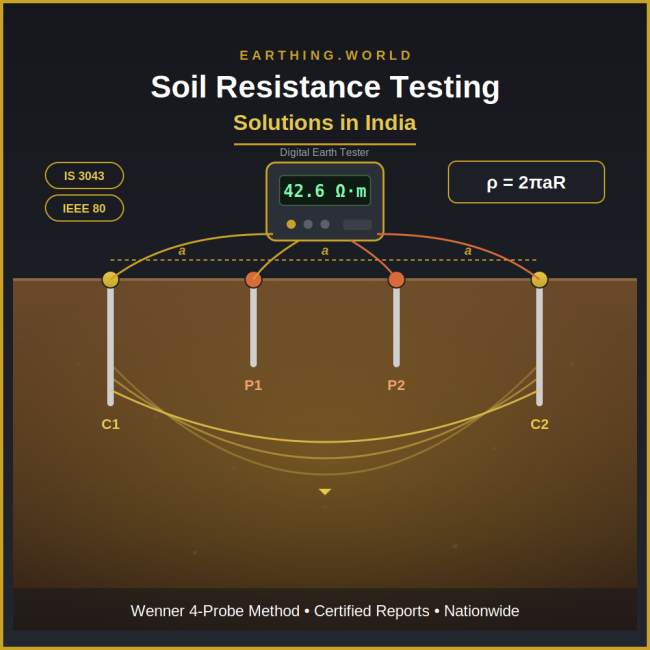
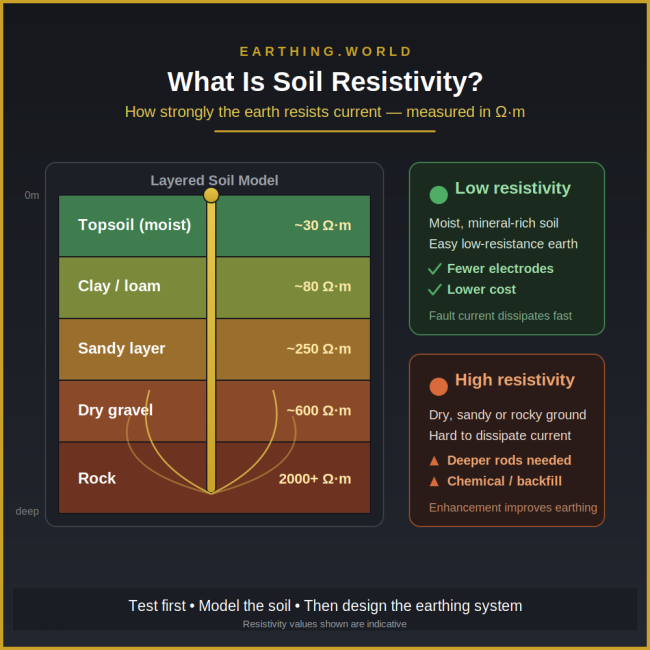
Soil resistivity testing measures how strongly the earth at a given site resists the flow of electric current, expressed in ohm-metres (Ω·m). It is the single most important data point in grounding design: it tells engineers whether the soil will dissipate a fault current in milliseconds or hold it dangerously near the surface. Because resistivity changes with depth and across a site, the test is performed at several probe spacings to build a layered “soil model” rather than relying on a single reading.
In practice, low resistivity (moist, mineral-rich soil) makes a low-resistance earth easy to achieve; high resistivity (dry, sandy or rocky ground) means more electrodes, deeper rods, or chemical / backfill enhancement are needed. Testing first — before design — is what separates a system that simply exists from one that actually protects.
Receive an accurate quote within 3-5 days when you fill out the form on this page. Or, give us a call: (+91 72900 43400)
Without accurate resistivity data, even a well-built earthing installation can fail under real fault conditions. Reliable testing underpins three outcomes that matter on every project:
It is also the difference between a design that is approved and one that is sent back: inspectors and consultants increasingly demand resistivity data and an interpreted soil model as evidence that the earthing design is engineered, not assumed.
Earthing is all we do. Our field teams have run resistivity surveys across substations, solar plants, factories, hospitals, data centres and critical defence infrastructure — the high-stakes sites where a poor earth is not an option. That focused experience shows up in three ways:
| Sector | Why resistivity testing is critical |
|---|---|
| Substations & power | Touch/step-voltage safety to IEEE 80 demands an accurate soil model. |
| Solar & renewables | Large arrays over varied ground need site-wide resistivity mapping. |
| Data centres | Very low earth resistance is achievable only with precise soil data. |
| Hospitals | Life-safety and sensitive equipment require fail-safe earthing. |
| Factories & industrial | High fault levels and machinery earthing depend on reliable ground. |
| Railways & infrastructure | Signalling, traction and station earthing rely on accurate soil data. |
Soil resistivity is not a fixed property. It rises in dry summers and falls when moisture and dissolved salts increase after rain, and it shifts with temperature and the depth of the water table. A reading taken on one wet morning can badly mislead a design if used unadjusted. We apply a seasonal variation factor (F) and, where the project warrants it, recommend the worst-case design condition — so the earthing system stays effective year-round, including the dry months when resistivity peaks and earthing is hardest to achieve.
We confirm project type, area, access and the standards you must meet.
Multiple traverses at increasing spacings, with perpendicular checks for interference.
Raw readings inverted into a layered soil model with seasonal adjustment.
A standards-referenced report your design engineer can use immediately.
We can carry the soil model straight into earthing design and product selection.
Our methodology and reporting are aligned to the standards your consultant and inspecting authority will check against:
For projects exporting equipment or following international practice, we can also report to ASTM G57 and IEC 62305, so the same survey serves both Indian compliance and global design teams.
A resistivity reading is only useful when it is interpreted. Every Earthing.World survey is delivered as an engineering document, not a spreadsheet of numbers:
Lower is better — low resistivity soil dissipates fault current more easily. There is no single universal figure; the target depends on the application and the maximum allowable earth resistance for that system. What matters is matching the design to the measured resistivity profile, which is exactly what testing establishes. As a rule of thumb, moist mineral-rich soils may read well under 100 Ω·m, while dry sandy or rocky ground can exceed 1,000 Ω·m and need enhancement.
The industry-standard technique is the Wenner four-probe method. Four equally spaced electrodes are driven into the ground; current is injected through the outer pair and voltage measured across the inner pair. Resistivity is then calculated as ρ = 2πaR, where ‘a’ is the electrode spacing and ‘R’ the measured resistance. Increasing the spacing reads deeper soil layers.
Resistivity should be measured at the design stage of every new installation, and re-tested whenever site conditions change significantly — major earthworks, added load, or a new structure. Because soil resistivity also shifts seasonally, critical sites benefit from periodic verification, typically alongside routine earth-resistance checks.
Earthing.World follows the Wenner method as recommended by IS 3043, IEEE 80 and IEEE Std 81, with reporting also available to ASTM G57 and IEC 62305 for export and international projects.
Both use four electrodes, but they space them differently. Wenner keeps all four equally spaced and is the most widely used for grounding design because of its strong signal-to-current ratio. Schlumberger places the potential probes closer together and is occasionally used for deeper or faster surveys, but it needs more sensitive instruments. For earthing design, Wenner is the standard choice.
Cost depends on site location, area, number of traverses and required turnaround. Because every project differs, we quote per site after a short scope review — contact us with your project details for an accurate figure.
Speak to Earthing World's certified earthing experts today for a free site assessment and a customised earthing solution that meets Indian safety standards.
Earthing World – India's Trusted Partner in Electrical Safety & Earthing Solutions.