
High Corrosion Resistance
Outlasts GI and MS in aggressive soil conditions, often delivering 20+ years of service life.
When it comes to electrical safety in India, copper earthing solutions are widely regarded as the gold standard. From hospitals and data centres in Delhi and Mumbai to manufacturing plants in Pune and Chennai, copper earthing electrodes are the go-to choice for engineers seeking long-term reliability.
But here’s a question every buyer should ask before placing an order: Is copper truly better than GI or MS earthing — or is that just a popular myth?
At Earthing World, we believe in informed buying. This guide cuts through the marketing noise and gives you the facts about copper earthing — based on Indian Standard IS:3043, real soil science, and decades of on-ground installation experience across India.
Don’t pay for a copper earthing system you may not need. Don’t compromise on safety with the wrong GI installation.
Talk to Earthing World — and get an honest, IS:3043-compliant earthing solution designed for your soil, your site, and your safety. Call us today | Request a free site consultation
Earthing World — Clarity. Compliance. Confidence.
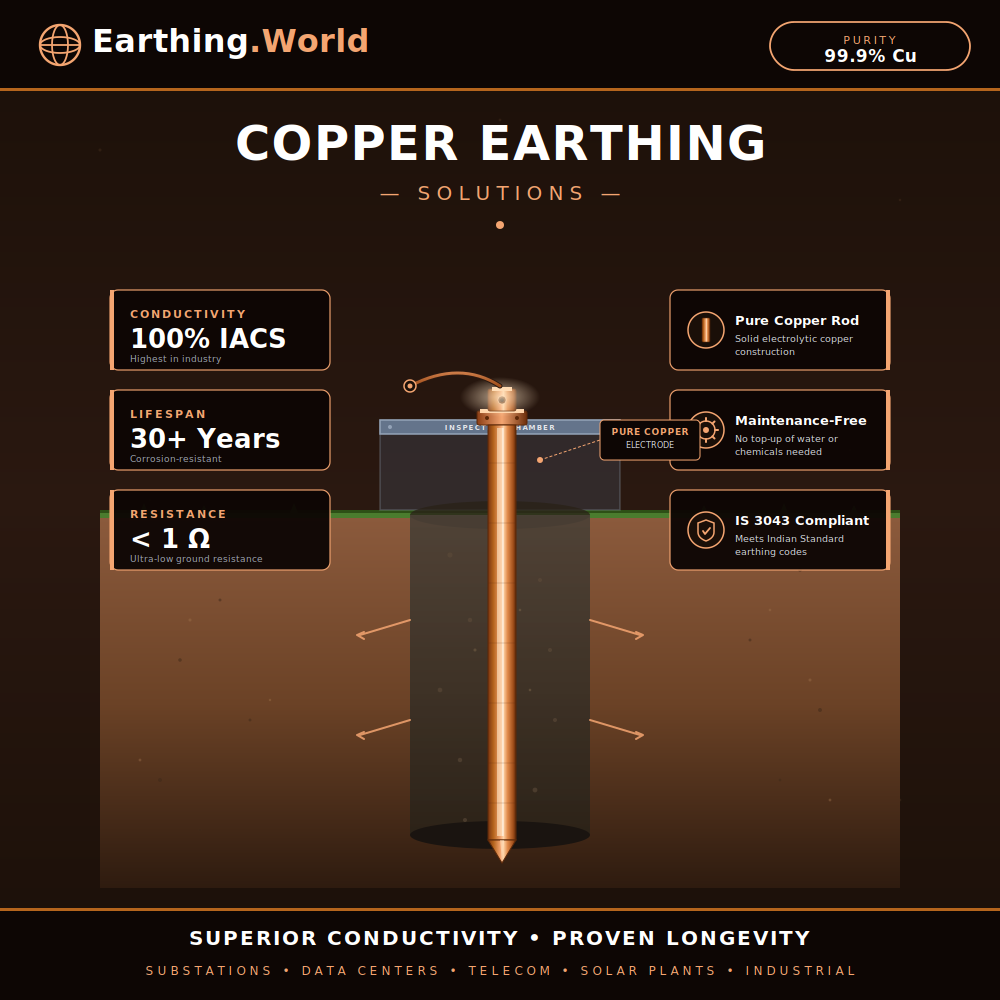
Copper earthing is a grounding method that uses pure copper rods, electrodes, or plates to create a safe, low-resistance path between an electrical system and the earth. This conductive path safely dissipates fault currents, protects equipment from electrical surges, and ensures the safety of personnel.
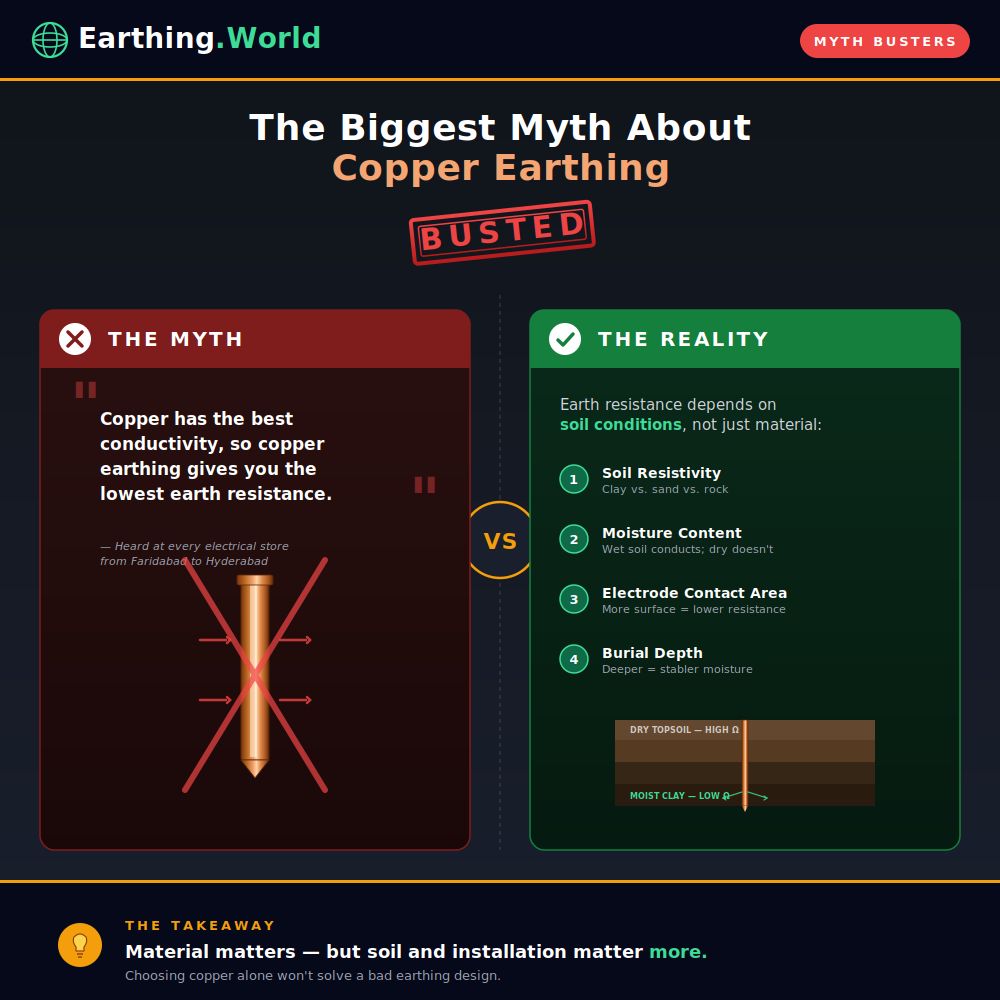
Walk into any electrical store from Faridabad to Hyderabad, and you’ll hear the same pitch: “Copper has the best conductivity, so copper earthing gives you the lowest earth resistance.”
It sounds logical. It’s also a misconception.
Let’s look at what actually determines earth resistance — and why this matters for your project budget.
Here is the engineering truth, supported by IS:3043 and decades of testing:
This is why a well-designed GI earthing system in moist clay soil will outperform a poorly designed copper earthing system in dry rocky soil — every single time.
Receive an accurate quote within 3-5 days when you fill out the form on this page. Or, give us a call: (+91 72900 43400)
Outlasts GI and MS in aggressive soil conditions, often delivering 20+ years of service life.
Maintains conductivity and earth resistance values consistently over time.
Often specified in international tenders, defence projects, and critical infrastructure where global standards (IEC, IEEE) apply.
Reduces the frequency of earth pit servicing and replacements.
Widely accepted in power generation, oil & gas, telecom, healthcare, data centres, and railway infrastructure.
We help you make value-driven decisions — choosing the right earthing system based on your soil conditions, regulatory requirements, and long-term reliability goals. Not based on brand perception or sales pressure. That’s how we deliver cost-effective electrical safety without compromising on quality or compliance.
So if copper doesn’t lower resistance, why is it still the preferred choice for premium installations?
The real benefit of copper earthing is durability.
So copper isn’t a magic conductor — it’s a long-term investment in reliability.
As per IS:3043, the standard copper earthing rod is 3 metres in length, with diameters typically ranging from 40 mm to 80 mm. Copper earthing plates are standardised at 600 × 600 mm with 3 mm thickness.
Not in terms of earth resistance. Soil resistivity determines earth resistance, not the electrode material. Copper’s real advantage is its superior corrosion resistance, which makes it last longer in harsh soil conditions.
Properly installed pure copper earthing electrodes can last 20 to 30 years or more, depending on soil conditions and maintenance practices.
Copper earthing electrode prices vary based on purity, diameter, length, and make. Generally, copper earthing costs 3 to 5 times more than GI earthing. Contact Earthing World for a transparent quote tailored to your site.
Copper earthing is recommended for hospitals, data centres, defence installations, substations, telecom towers, refineries, and any site with corrosive soil or critical uptime requirements.
Yes. We provide end-to-end services — soil resistivity testing, earth pit design, supply, installation, and earth resistance certification — across India.
Sourced primarily from Gujarat, India, Bentonite clay is renowned for its exceptional ability to absorb water and swell. In a chemical earthing system, Bentonite:
Chemical earthing operates on the scientific principle of ionic conduction. Electrons require a medium to flow, and the salts present in the earthing compound act as that medium by releasing ions when dissolved in water.
This ion movement allows the soil to:
In simple terms, chemical earthing turns the surrounding soil into an efficient conductor — a vital function for every modern electrical installation.
Contact UsMany vendors market chemical earthing as a “maintenance-free earthing system”, but at Earthing World, we believe in transparency. Here are the real-world limitations every buyer in India should understand:
This is why expert consultation and routine inspection are essential for long-term reliability.
Don't gamble with electrical safety. Speak to Earthing World's certified earthing experts today for a free site assessment and a customised earthing solution that meets Indian safety standards.
Earthing World – India's Trusted Partner in Electrical Safety & Earthing Solutions.