
Site & soil assessment
Our engineers measure soil resistivity and inspect the existing electrical setup.
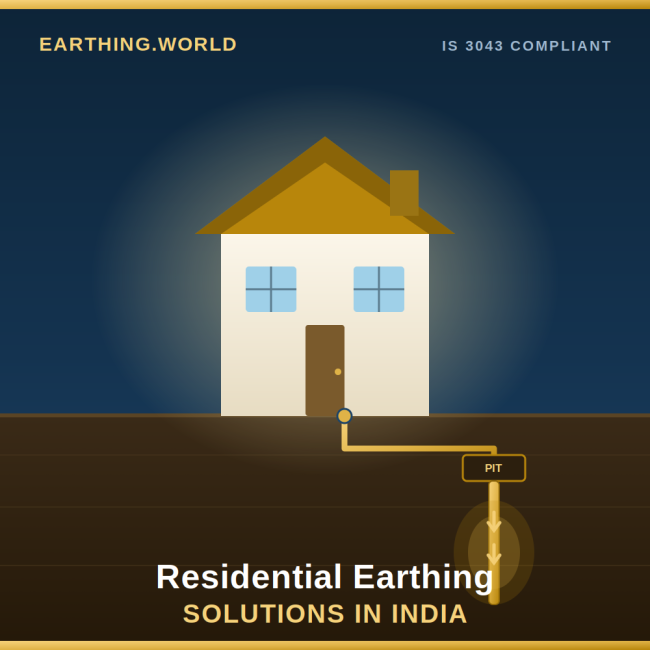
Your home is the one place that should always feel safe — yet hidden electrical faults remain one of the most overlooked household risks. A properly engineered earthing system quietly does the most important job in your electrical setup: it gives fault current and surges a safe path into the ground, away from your family and your appliances. At Earthing.World, we design, install and certify residential earthing systems that meet IS 3043:2018, IS 732 and CEA requirements, so your home stays protected, compliant and future-ready.
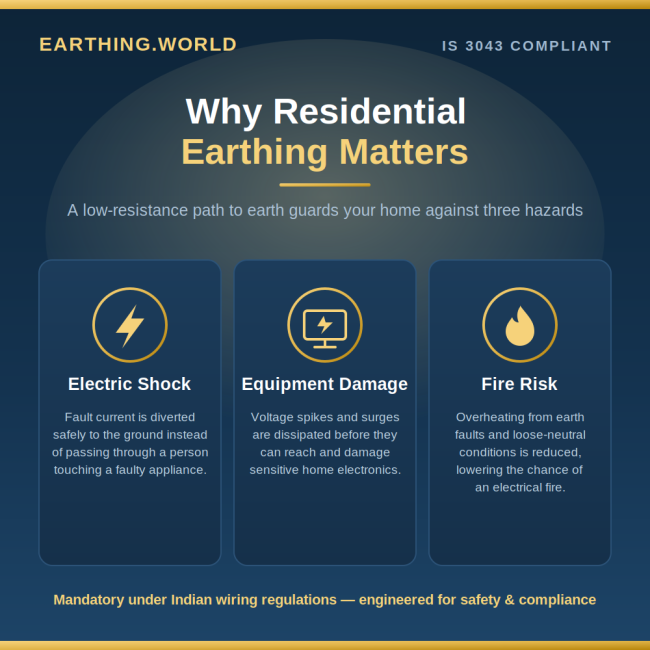
Modern homes run far more electrical load than the houses they replaced — air conditioners, inverters and UPS backups, induction cooktops, EV chargers, water heaters and a growing list of sensitive electronics. Without a low-resistance path to earth, a single insulation failure or surge can pass dangerous voltage onto metal appliance bodies, wiring and fixtures. Effective earthing protects against three distinct hazards:
Indian wiring regulations make earthing mandatory for exactly these reasons. A well-designed system also stabilises appliance performance against voltage fluctuation and extends the working life of your electrical installation.
Receive an accurate quote within 3-5 days when you fill out the form on this page. Or, give us a call: (+91 72900 43400)
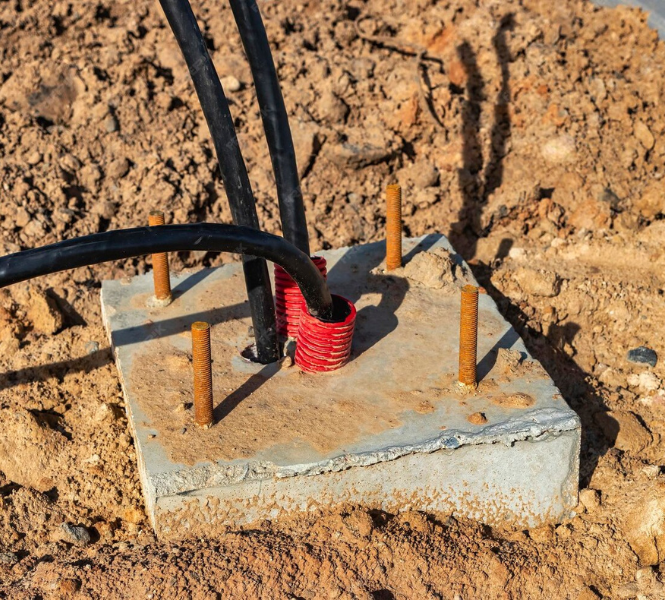
A residential earthing system is judged on one core number — its earth resistance. For a home, the goal is a stable, low resistance value (typically measured against the limits in IS 3043), maintained year-round regardless of soil moisture or season. Three things decide whether you achieve that: the electrode material, the soil condition, and the quality of installation. This is why the “best” earthing for one house can be the wrong choice for another — the right answer depends on your soil and your load, not on a one-size-fits-all package.
Electrical safety is not only about the installation — it is about proof. Every system we deliver is designed and tested to IS 3043:2018, IS 732 and applicable CEA regulations, and you receive a measured earth-resistance test report on completion. That documentation matters for safety, for insurance and for any future property due diligence, giving you written assurance that your home is genuinely protected, not just nominally earthed.
Conventional GI-pipe earthing often struggles in India’s varied soils — it dries out, corrodes and drifts to a higher resistance within a few years. That is why we specify engineered earthing compounds such as Marconite and Duraphite for homes that need dependable, permanent grounding. Unlike salt-and-charcoal backfill, these compounds set into a compact, permanently conductive mass around the electrode and hold a low, stable resistance regardless of moisture, temperature or season. The result:
A safe earthing system is the result of disciplined process, not just digging a pit. Every Earthing.World residential project follows the same five-step, fully documented workflow:
Our engineers measure soil resistivity and inspect the existing electrical setup.
We select the electrode and compound suited to your soil, load and space.
The electrode is installed to the correct depth and surrounded with the engineered backfill compound.
Conductors link the electrode to your main distribution board and metallic services.
We verify the earth resistance with a calibrated earth tester and hand over a test report and compliance documentation.
There is no single “best” earthing type; there is only the right type for your soil, space and budget. Here is how the common residential options compare.
| Earthing Type | Best Suited For | Trade-off |
|---|---|---|
| GI pipe earthing | Budget installs in moist, low-resistivity soil; small homes | Shorter life; needs periodic watering and maintenance |
| Plate earthing | Standard homes where deep excavation is feasible | Plates can corrode in acidic/alkaline soil; needs space |
| Chemical earthing | Dry, sandy or rocky soil; inverter/UPS loads; low maintenance | Higher upfront cost; superior long-term reliability |
| Engineered (Marconite / Duraphite) | Tough soils, premium homes, lightning-prone areas, fit-and-forget | Premium investment; lowest lifetime maintenance |
No two properties share the same soil, layout or electrical load, so we never quote blind. Every installation begins with an on-site assessment and a soil resistivity test, and the design is then tailored to the property type:
It depends on your soil and load. Chemical or engineered-compound earthing gives the most stable, low-maintenance performance — especially in dry or rocky soil — while plate or GI-pipe earthing can suit homes in moist, low-resistivity soil on a tighter budget. A soil resistivity test confirms the right choice.
A well-installed chemical earthing system from Earthing World typically lasts 10–15 years, depending on soil and climatic conditions. Most 2BHK–3BHK homes need at least two pits — one for electrical safety and one for backup or lightning protection — but the exact number depends on your load and soil condition.
Conventional GI earthing often lasts only a few years before resistance rises, whereas engineered chemical earthing can hold a stable, low resistance for 15–20 years or more with minimal maintenance.
Yes. Indian wiring rules and CEA regulations require electrical installations to be properly earthed, and systems should be designed and tested to IS 3043:2018.
The standard depth is approximately 3 metres, with a 100 mm diameter bore and a 17.2 mm electrode.
Homeowners researching residential earthing almost always ask about price first — so it helps to understand what actually drives the cost. The final figure depends on four factors rather than a fixed rate:
Rather than publish a flat rate, we give a transparent, itemised quote after the site survey — so you pay for a system sized correctly for your home, not for an over- or under-specified package.
Contact UsBook a residential earthing assessment today. Our engineers will test your soil, recommend the right system for your home and give you a transparent, itemised quote — with full IS 3043-compliant documentation on completion.
Many vendors market chemical earthing as a “maintenance-free earthing system”, but at Earthing World, we believe in transparency. Here are the real-world limitations every buyer in India should understand:
This is why expert consultation and routine inspection are essential for long-term reliability.
Don't gamble with electrical safety. Speak to Earthing World's certified earthing experts today for a free site assessment and a customised earthing solution that meets Indian safety standards.
Earthing World – India's Trusted Partner in Electrical Safety & Earthing Solutions.