
Plate Earthing Solutions – Conventional & Corrosion-Free Systems
Reliable earthing protects every life and every rupee of equipment inside your facility. At Earthing.World, we design, supply and install GI and copper plate earthing systems that comply with IS 3043, IS 732 and CEA regulations — and where you need it, we upgrade you to maintenance-free, corrosion-resistant earthing that lasts for over five decades.
Whichever path fits your soil and load, you get a documented, tested, compliant earth.
- 50+ yrsEngineered system life
- IS 3043CEA & IS 732 compliant
- ZeroMaintenance upgrades
- Pan-IndiaSurvey → install → test report
Industries We Serve
Manufacturing plants & factories, hospitals & healthcare, data centres & IT, power & solar installations, commercial towers, defence & critical infrastructure.
What Is Plate Earthing?
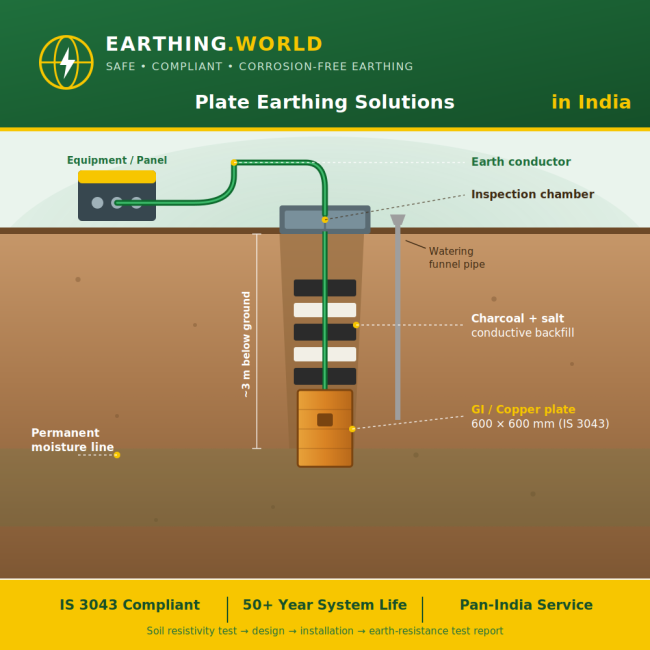
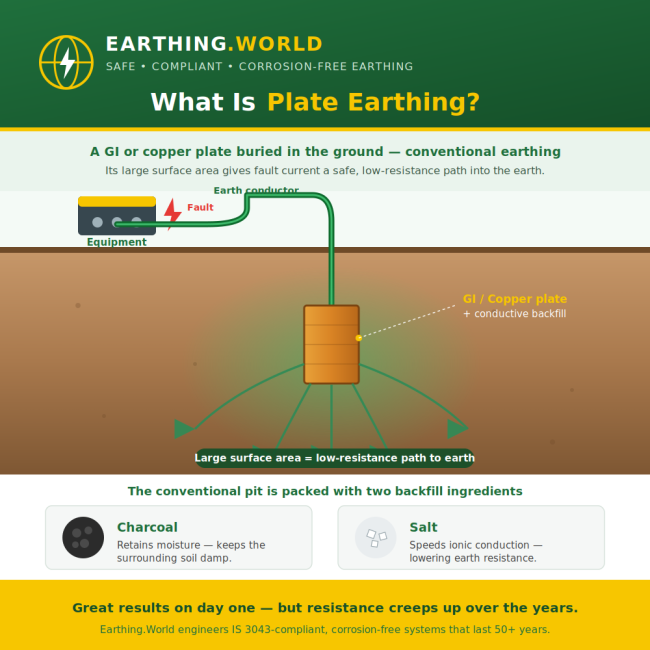
Plate earthing is one of the oldest and most widely used grounding methods in electrical engineering — often called conventional earthing. A metal plate, usually galvanised iron (GI) or copper, is buried vertically in the ground and surrounded by a conductive backfill. The plate's large surface area gives fault currents a safe, low-resistance path to dissipate into the earth, shielding equipment from damage.
In a traditional pit, the plate is packed with alternate layers of charcoal and salt:
- Charcoal retains moisture and keeps the surrounding soil damp.
- Salt accelerates ionic conduction, lowering earth resistance.
Initially this delivers excellent, low-resistance results. The challenge — as every facilities engineer eventually discovers — is what happens over the next few years.
What People Saying About Our Services
Book an Appointment
Receive an accurate quote within 3-5 days when you fill out the form on this page. Or, give us a call: (+91 72900 43400)
Plate Earthing Specifications as per IS 3043
A correctly engineered plate earthing system follows defined material, dimension and depth standards. These are the benchmarks our engineers design and verify against:
| Parameter | Copper plate | GI plate |
|---|---|---|
| Standard plate size | 600 × 600 × 3.15 mm | 600 × 600 × 6 mm |
| Larger duty option | 1.2 × 1.2 m | 1.2 × 1.2 m |
| Burial | Vertical, below permanent moisture level | Vertical, below permanent moisture level |
| Typical depth (top of plate) | ~3 m below ground level | ~3 m below ground level |
| Backfill (conventional) | Alternate charcoal & salt layers | Alternate charcoal & salt layers |
| Target earth resistance | ≤ 5 Ω (domestic) / ≤ 1 Ω (industrial) | ≤ 5 Ω (domestic) / ≤ 1 Ω (industrial) |
| Pit spacing | 2 × electrode length between pits | 2 × electrode length between pits |
Earth resistance follows the IS 3043 relationship for a plate electrode — it is governed mainly by soil resistivity and plate surface area, which is exactly why a soil resistivity test should precede any design.
We don't just hand over products — we deliver confidence, compliance and sustainability, backed by documentation you can show any auditor or electrical inspector.
Why Choose Earthing.World
- Standards-first engineering. Every design is verified against IS 3043 and CEA guidelines.
- Soil-led design. We test before we recommend — soil resistivity dictates material, size and method.
- Lifetime value. Maintenance-free systems engineered for 50+ years, not a few monsoon seasons.
- Environmentally responsible. Non-polluting backfills that protect soil and groundwater.
- Documented & tested. You receive earth-resistance test readings and a compliance record on handover.
The chemical earthing installation process by Earthing World follows a precise, standards-compliant methodology.
Plate Earthing Installation Process – Our Process
-
Site survey & soil resistivity test
We measure before we design.
-
System design
Method, material and electrode count selected to your fault current and soil.
-
Supply & installation
Executed to IS 3043 by trained technicians.
-
Earth-resistance testing
Measured, verified and recorded.
-
Documentation & handover
Compliance record and test report provided.
Stop paying for earthing that corrodes. Book a free site survey and our engineers will test your soil, recommend the right plate or maintenance-free system, and give you a transparent quote with a documented compliance plan.
Plate Earthing vs Pipe Earthing vs Chemical Earthing
Most buyers are weighing plate earthing against the alternatives. Here is the honest engineering comparison:
| Factor | Plate earthing | Pipe earthing | Chemical / maintenance-free |
|---|---|---|---|
| Electrode | Flat GI/Cu plate | Vertical GI/Cu pipe | Pipe + engineered compound |
| Surface area / capacity | Large – high current capacity | Smaller | High & stable |
| Space needed | More excavation | Less – compact | Compact |
| Best suit | Good-conductivity soil | Low-resistivity, moist soil | All, incl. dry/rocky |
| Maintenance | Periodic (water/salt) | Periodic | Effectively zero |
| Initial cost | Moderate | Low–moderate | Higher upfront |
| Typical life | Years (corrosion-limited) | Years | 50+ years |
There is no single "best" — the right method depends on soil resistivity, available space, criticality and budget. Our job is to recommend the one that gives you the lowest lifetime cost per ohm, not just the cheapest pit on day one.
GI vs Copper Plate – Which Material?
- Copper – superior conductivity and corrosion resistance, longer life; preferred for critical, high-fault-current installations.
- Galvanised iron (GI) – zinc-coated, economical and dependable for general-purpose use in stable soils.
Frequently Asked Questions (FAQs) – Plate Earthing Solutions in India
Plate earthing buries a GI or copper plate vertically in the ground, surrounded by conductive backfill. Its large surface area dissipates fault current safely into the earth, protecting people and equipment from shock and damage.
Typically a 600 × 600 × 3.15 mm copper plate or a 600 × 600 × 6 mm GI plate, buried vertically about 3 m below ground level — ideally below the permanent moisture line.
Plate earthing offers a larger surface area and higher current capacity but needs more space. Pipe earthing is compact and economical and often performs better in moist, low-resistivity soil. The best choice depends on soil, load and space.
Charcoal and salt keep resistance low initially, but the salt leaches away and the plate corrodes — the corroded layer acts as an insulator, raising resistance and forcing periodic re-charging of the pit.
Systems built with engineered compounds like Marconite or Durophite are designed for stable, low-resistance performance for over five decades with effectively zero maintenance.
Copper gives better conductivity, corrosion resistance and life for critical installations; GI is more economical for general use. A soil resistivity test should guide the decision.
The Hidden Cost of Conventional Plate Earthing
We will tell you what most suppliers won't: a charcoal-and-salt plate pit that looks perfect on installation day develops two failure modes over time.
1. Soil & groundwater pollution
Salt slowly leaches into rainwater and groundwater over time, spreading through the earth. This both reduces the pit's effectiveness and contaminates soil — a real concern in India, where millions depend on groundwater for drinking.
2. Accelerated corrosion
Moisture, soil oxygen and heat create ideal conditions for corrosion. The plate develops a thick corroded layer that behaves as an insulator rather than a conductor. The result:
- Earth-pit resistance rises
- Fault-current flow is restricted
- Frequent re-charging, maintenance or replacement is needed
Severity scales with soil resistivity and how often water and salt are used — so the "fix" (more salt) accelerates the "problem" (corrosion and pollution).
The Upgrade: Corrosion-Free, Maintenance-Free Earthing
Modern earthing removes both problems. Instead of charcoal and salt, we use stable, non-polluting, conductive compounds such as Marconite and Durophite. Unlike conventional backfill, these engineered materials:
- Maintain consistent conductivity year after year
- Do not leach salt into soil or groundwater
- Deliver dependable performance for more than five decades
For industries, hospitals, defence establishments, data centres and other critical infrastructure, this means zero-maintenance earthing, sustained compliance and genuine peace of mind.
Note for engineers: these are maintenance-free / chemical-backfill earthing technologies. The plate-earthing electrode principle is retained where suitable; the backfill and electrode metallurgy are upgraded for longevity.
Contact Us