Types of Earthing Systems We Deploy for Solar Installations
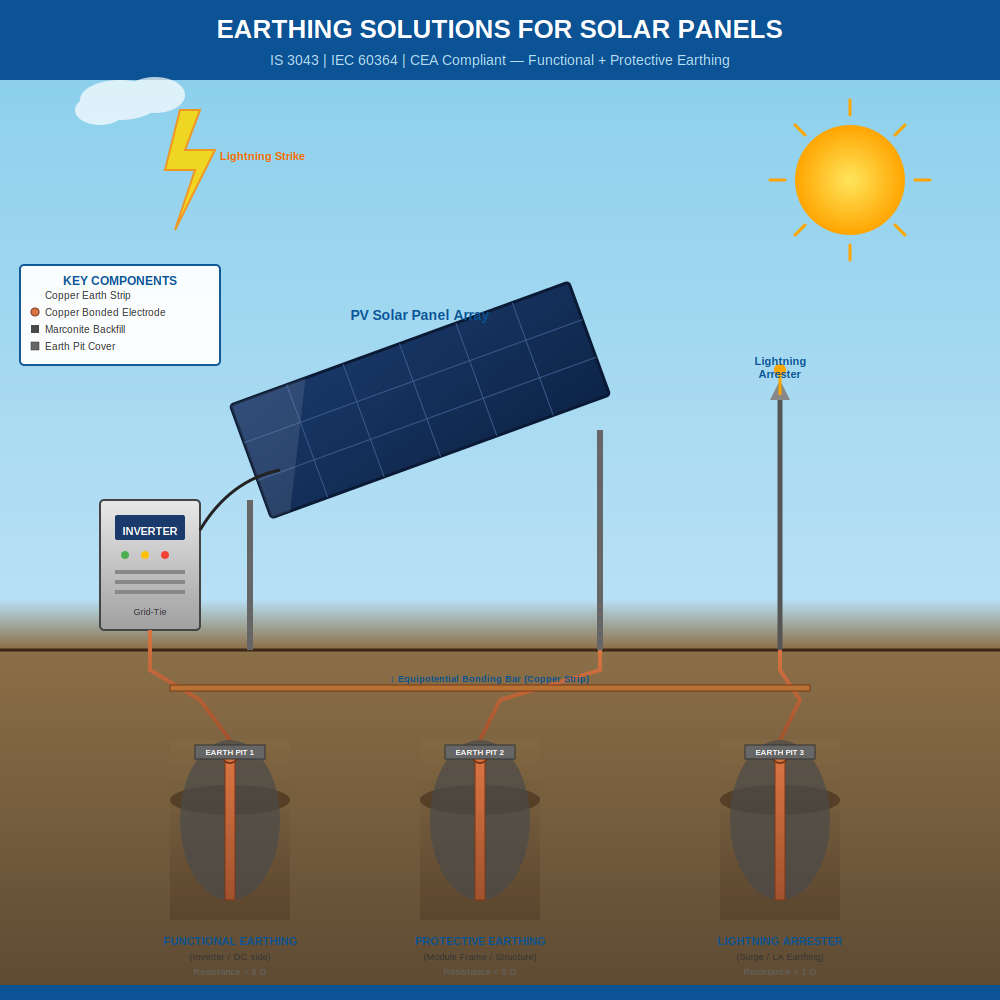
No two sites are alike. Soil resistivity, available space, water table, ambient corrosion, and lightning frequency all dictate the type of earthing electrode and backfill compound that will give you a 25-year-stable system. Below are the earthing solutions we engineer for solar projects.
1. Marconite Earthing (Our Premium Recommendation for Solar)
Marconite is a synthetic, carbon-based conductive aggregate that is mixed with cement to form a permanent low-resistance mass around the earth electrode. With a resistivity of approximately 0.1 Ω-m, it is the gold standard for solar EPC projects in India where long-life, maintenance-free performance is non-negotiable. Marconite earthing systems are non-corrosive, work in rocky and sandy soils, require zero replenishment of water or charcoal, and carry a service life of 25 to 50 years — outlasting most solar plants by a wide margin.
2. Chemical Earthing (Cost-Optimised Option)
Chemical earthing — also known as conventional chemical earthing or BFC earthing — uses bentonite, graphite, or proprietary backfill compounds around copper-bonded electrodes or GI pipe-in-pipe electrodes. It is the most widely deployed earthing system in Indian residential and small commercial rooftop solar installations because of its lower upfront cost. However, it does require periodic replenishment (usually water topping every 6–12 months and chemical refilling every 3–5 years) and is sensitive to soil moisture.
3. Copper-Bonded and GI Earth Electrode Systems
For sites where a fully engineered backfill is not feasible, we deploy copper-bonded steel electrodes or GI pipe-in-pipe electrodes with appropriate earth-enhancing compounds. These earthing kits include the earth electrode, earth pit cover, terminal, earth strip, and connection accessories, and are commonly used to ground combiner boxes, mounting structures, and individual array sections.
4. Lightning Protection and Surge Protection Earthing
Module to module earthing means electrically bonding the metal frame of every solar panel to the next using grounding clips, bonding jumpers or star washers, so the entire array behaves as one continuous earthed structure. If even a single frame is left unbonded, it can float at a dangerous touch voltage during a fault or lightning strike. We bond every module frame and mounting structure to the protective earthing network as per IS 3043 and MNRE technical specifications — a step that most budget installers skip entirely.