Copper Earthing Solutions in India: Myths, Facts & The Smarter Way to Choose

When it comes to electrical safety in India, copper earthing solutions are widely regarded as the gold standard. From hospitals and data centres in Delhi and Mumbai to manufacturing plants in Pune and Chennai, copper earthing electrodes are the go-to choice for engineers seeking long-term reliability.

But here’s a question every buyer should ask before placing an order: Is copper truly better than GI or MS earthing — or is that just a popular myth?

At Earthing World, we believe in informed buying. This guide cuts through the marketing noise and gives you the facts about copper earthing — based on Indian Standard IS:3043, real soil science, and decades of on-ground installation experience across India.

Get the Right Copper Earthing Solution — Talk to Earthing World Today

Don’t pay for a copper earthing system you may not need. Don’t compromise on safety with the wrong GI installation.

Talk to Earthing World — and get an honest, IS:3043-compliant earthing solution designed for your soil, your site, and your safety. 📞 Call us today | 📧 Request a free site consultation |

Earthing World — Clarity. Compliance. Confidence.

copper_earthing_solutions_1000x1000
Earthing.World

What Is Copper Earthing?

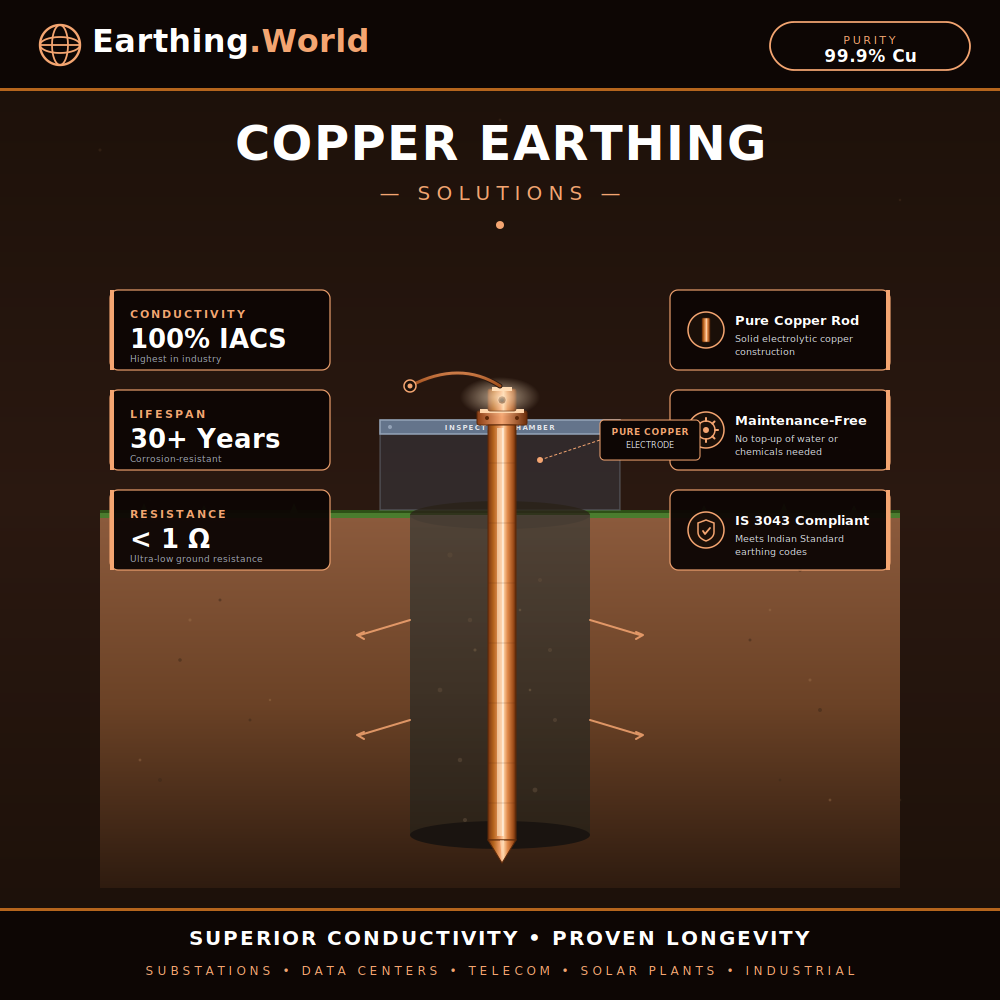
Copper earthing is a grounding method that uses pure copper rods, electrodes, or plates to create a safe, low-resistance path between an electrical system and the earth. This conductive path safely dissipates fault currents, protects equipment from electrical surges, and ensures the safety of personnel.

The Biggest Myth About Copper Earthing — Busted

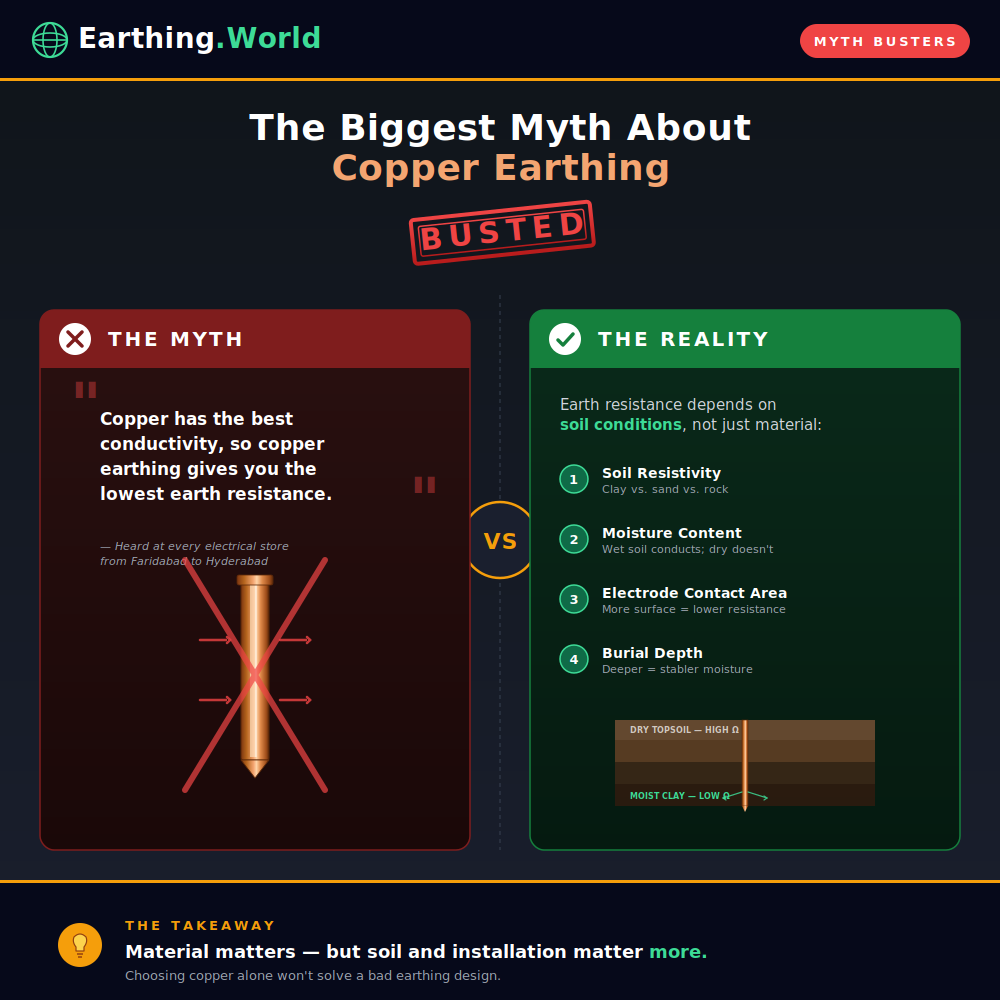
Walk into any electrical store from Faridabad to Hyderabad, and you’ll hear the same pitch: “Copper has the best conductivity, so copper earthing gives you the lowest earth resistance.”

It sounds logical. It’s also a misconception.

Let’s look at what actually determines earth resistance — and why this matters for your project budget.

Earth Resistance Depends on Soil, Not the Metal

Here is the engineering truth, supported by IS:3043 and decades of testing:

  • The effectiveness of any earthing system is determined primarily by soil resistivity — not the material of the electrode.
  • If you take a copper electrode, a GI (Galvanised Iron) electrode, and an MS (Mild Steel) electrode of the same size and shape, and install them in the same soil, the earth resistance value will be virtually identical.
  • In other words, copper does not magically lower your earth resistance. The soil does the work.

This is why a well-designed GI earthing system in moist clay soil will outperform a poorly designed copper earthing system in dry rocky soil — every single time.

Testimonial

What People Saying About Our Services

Submit Enquiry

Book an Appointment

Review an accurate quote within 3-5 days when you fill out the form on this page. Or, give us a call: (+91 72900 43400)

    Advantages of Copper Earthing Solution in India

    High Corrosion Resistance
    Outlasts GI and MS in aggressive soil conditions, often delivering 20+ years of service life.
    Stable Long-Term Performance
    Maintains conductivity and earth resistance values consistently over time.
    Premium Compliance
    Often specified in international tenders, defence projects, and critical infrastructure where global standards (IEC, IEEE) apply.
    Low Maintenance
    Reduces the frequency of earth pit servicing and replacements.
    Trusted Across Industries
    Widely accepted in power generation, oil & gas, telecom, healthcare, data centres, and railway infrastructure.
    Earthing.World

    Our Commitment to You

    We help you make value-driven decisions — choosing the right earthing system based on your soil conditions, regulatory requirements, and long-term reliability goals. Not based on brand perception or sales pressure. That's how we deliver cost-effective electrical safety without compromising on quality or compliance.

    Copper’s Real Advantage: Corrosion Resistance, Not Conductivity

    So if copper doesn’t lower resistance, why is it still the preferred choice for premium installations?

    The real benefit of copper earthing is durability.

    ·        Copper has superior corrosion resistance compared to GI or MS.

    ·        This makes copper earthing electrodes longer-lasting in harsh, acidic, or saline soil conditions — common in coastal regions of India like Mumbai, Chennai, Vizag, and Kochi.

    ·        Copper ensures decades of reliable performance with minimal maintenance, which is critical for hospitals, defence facilities, data centres, telecom towers, and continuous-process industries where downtime is unacceptable.

    So copper isn’t a magic conductor — it’s a long-term investment in reliability.

    Frequently Asked Questions (FAQs) – Copper Earthing Solutions India

    What is the standard size of a copper earthing electrode in India?

    As per IS:3043, the standard copper earthing rod is 3 metres in length, with diameters typically ranging from 40 mm to 80 mm. Copper earthing plates are standardised at 600 × 600 mm with 3 mm thickness.

    Is copper earthing really better than GI earthing?

    Not in terms of earth resistance. Soil resistivity determines earth resistance, not the electrode material. Copper's real advantage is its superior corrosion resistance, which makes it last longer in harsh soil conditions.

    How long does a copper earthing electrode last?

    Properly installed pure copper earthing electrodes can last 20 to 30 years or more, depending on soil conditions and maintenance practices.

    What is the price of copper earthing in India?

    Copper earthing electrode prices vary based on purity, diameter, length, and make. Generally, copper earthing costs 3 to 5 times more than GI earthing. Contact Earthing World for a transparent quote tailored to your site.

    Where is copper earthing recommended?

    Copper earthing is recommended for hospitals, data centres, defence installations, substations, telecom towers, refineries, and any site with corrosive soil or critical uptime requirements.

    Does Earthing World offer installation services?

    Yes. We provide end-to-end services — soil resistivity testing, earth pit design, supply, installation, and earth resistance certification — across India.

    Bentonite Clay – The Backbone of Chemical Earthing

    Sourced primarily from Gujarat, India, Bentonite clay is renowned for its exceptional ability to absorb water and swell. In a chemical earthing system, Bentonite:

    • Retains moisture around the electrode for extended periods
    • Acts as a thermal shield, protecting the rod from heat damage
    • Stabilises soil resistivity for consistent earthing performance
    • Reduces the impact of seasonal changes on earth resistance

    How Chemical Earthing Works – The Principle of Ionic Conduction

    Chemical earthing operates on the scientific principle of ionic conduction. Electrons require a medium to flow, and the salts present in the earthing compound act as that medium by releasing ions when dissolved in water.

    This ion movement allows the soil to:

    • Safely absorb fault currents
    • Dissipate electrical energy quickly into the ground
    • Protect both people and electrical equipment from harm

    In simple terms, chemical earthing turns the surrounding soil into an efficient conductor — a vital function for every modern electrical installation.

    Limitations of Chemical Earthing You Should Know

    Many vendors market chemical earthing as a “maintenance-free earthing system“, but at Earthing World, we believe in transparency. Here are the real-world limitations every buyer in India should understand:

    • Rainwater Leaching: Continuous rainfall can dissolve salts in the earthing compound, causing them to leach deeper into the soil.
    • High Groundwater Levels: If the water table lies within the earthing depth, salts may wash away faster than expected.
    • Resistance Build-Up Over Time: As salts deplete, earth resistance increases, gradually reducing system performance.
    • Recharging Required: Periodic recharging or replacement of the earthing compound is necessary in many Indian climatic conditions — especially in coastal and high-rainfall regions.

    This is why expert consultation and routine inspection are essential for long-term reliability.

    Get a Free Earthing Consultation from Earthing World

    Don’t gamble with electrical safety. Speak to Earthing World’s certified earthing experts today for a free site assessment and a customised chemical earthing solution that meets Indian safety standards.

    📞 Call Now | 📧 Request a Quote | 🌐 Visit www.earthingworld.com

    Earthing World – India’s Trusted Partner in Electrical Safety & Earthing Solutions.