
Earthing Solutions for Hospitals: Protect Every Patient, Every Procedure, Every Machine

In a hospital, the earthing system is not background infrastructure — it is a first line of life-safety. A single unaddressed fault current can stop a ventilator, corrupt an ICU monitor, or trigger a fire in a wing full of patients who cannot evacuate on their own. That is the reality our earthing solutions for hospitals are designed to prevent.

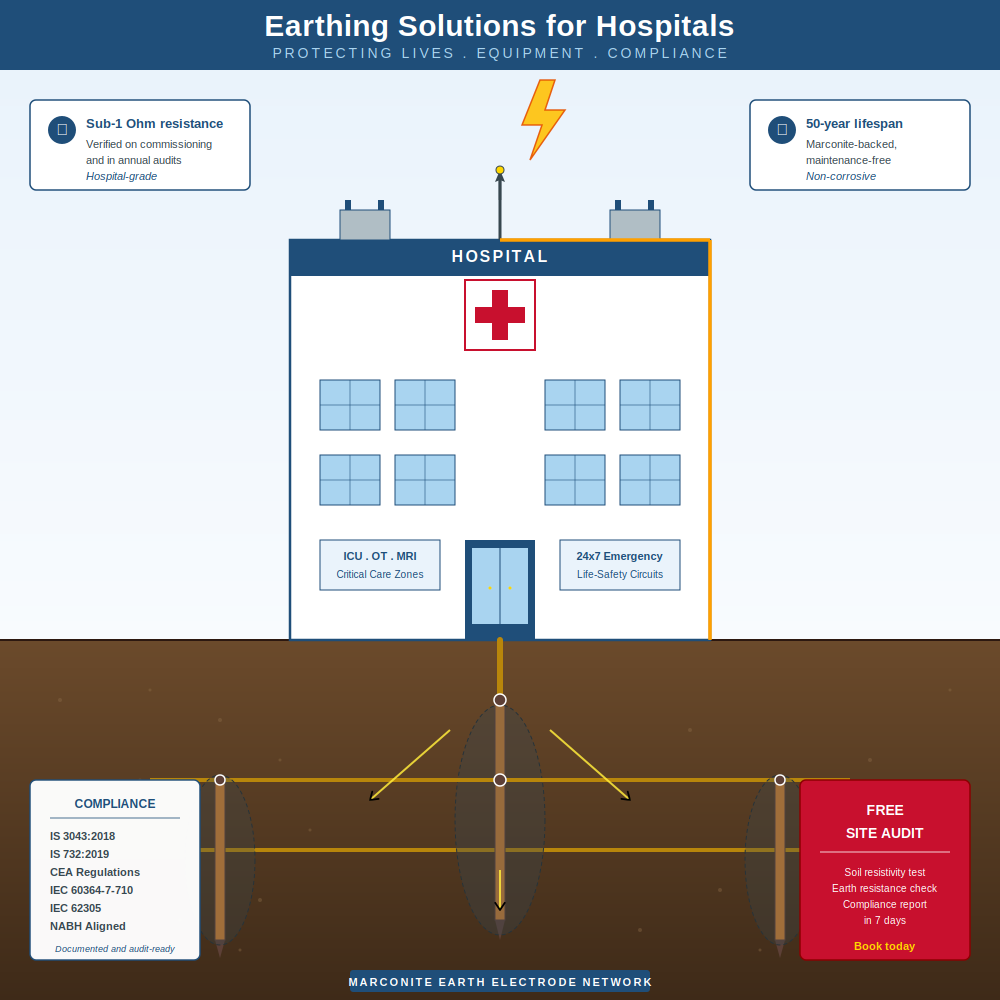
We design, install, and certify hospital earthing systems that protect three things at once: human life, multi-crore medical equipment, and your compliance position under IS 3043, IS 732, and CEA Regulations. From the operation theatre to the DG-set room, every electrode, every bond, every test is engineered for healthcare-grade reliability.

Trusted by hospitals across India for:

  • Sub-1 Ω ground resistance, verified on commissioning and in annual audits
  • Maintenance-free Marconite & engineered chemical earthing — no annual top-ups, no surprise downtime
  • Full compliance documentation for NABH audits, fire NOC renewals & insurance
  • Specialised installation for MRI, CT, cath labs, ICUs, OTs, NICUs and emergency departments

What goes wrong with non-specialised hospital earthing

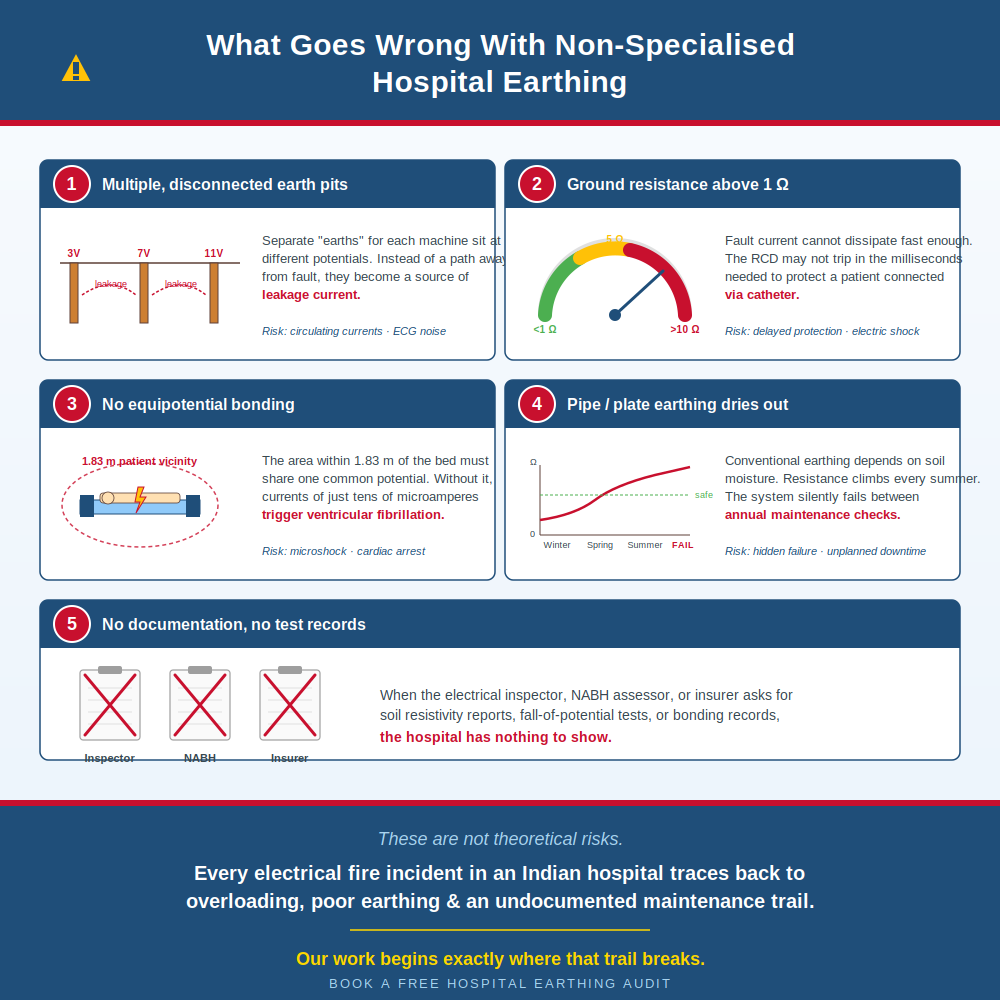
  • Multiple, disconnected earth pits — separate “earths” for each machine, sitting at different potentials, become a source of leakage current rather than a path away from it.
  • Ground resistance above 1 Ω — fault current cannot dissipate fast enough; the residual current device may not trip in the window needed to protect a patient connected via catheter.
  • No equipotential bonding in the patient vicinity — the area within 1.83 m of the bed must be at one common potential; without it, currents as low as a few tens of microamperes can cause ventricular fibrillation (microshock).
  • Conventional pipe / plate earthing that dries out — resistance climbs through summer, and the system silently fails between annual checks.
  • No documentation, no test records — when the electrical inspector, NABH assessor, or insurer asks, the hospital has nothing to show.

These are not theoretical risks. Every electrical fire incident in an Indian hospital that has made the news in recent years traces back to a combination of overloading, poor earthing, and an undocumented maintenance trail. Our work begins exactly where that trail breaks.

Testimonial

What People Saying About Our Services

Submit Enquiry

Book an Appointment

Review an accurate quote within 3-5 days when you fill out the form on this page. Or, give us a call: (+91 72900 43400)

    Earthing Solutions for Hospitals: Protect Every Patient, Every Procedure, Every Machine

    In a hospital, the earthing system is not background infrastructure — it is a first line of life-safety. A single unaddressed fault current can stop a ventilator, corrupt an ICU monitor, or trigger a fire in a wing full of patients who cannot evacuate on their own. That is the reality our earthing solutions for hospitals are designed to prevent.

    We design, install, and certify hospital earthing systems that protect three things at once: human life, multi-crore medical equipment, and your compliance position under IS 3043, IS 732, and CEA Regulations. From the operation theatre to the DG-set room, every electrode, every bond, every test is engineered for healthcare-grade reliability.

    Trusted by hospitals across India for:

    • Sub-1 Ω ground resistance, verified on commissioning and in annual audits
    • Maintenance-free Marconite & engineered chemical earthing — no annual top-ups, no surprise downtime
    • Full compliance documentation for NABH audits, fire NOC renewals & insurance
    • Specialised installation for MRI, CT, cath labs, ICUs, OTs, NICUs and emergency departments
    Earthing.World

    Why Hospitals Cannot Afford Generic Earthing

    Hospitals are categorised by national and international standards (IS 732, IEC 60364-7-710) into specific classes of electrical installations — Group 0, Group 1, and Group 2 medical locations — each with strict requirements for earthing, equipotential bonding, and isolated power systems. Yet on the ground, an estimated nine out of ten facilities still rely on the same local electrician who maintains the building wiring. That mismatch is the single biggest reason behind preventable hospital electrical fires, micro-shock incidents in the patient vicinity, and unplanned downtime of life-support systems.

    Hospital Zones We Earth (and Why Each Needs Its Own Strategy)

    Operation Theatres & Cath Labs
    OTs and cath labs are Group 2 medical locations — failure of the supply during a procedure is unacceptable. We install isolated power systems with line-isolation monitors, supplementary equipotential bonding, and a dedicated low-impedance earth tied into the patient-vicinity bus.
    ICU, NICU, CCU & HDU
    Patients here are continuously connected to monitors, infusion pumps, and ventilators. Equipotential bonding around every bed bay is mandatory, and we keep stray currents below the microshock threshold by design.
    MRI, CT Scan, X-Ray & Imaging Rooms
    Imaging equipment is OEM-sensitive to ground potential. We provide a dedicated, isolated earth meeting the manufacturer's resistance spec (typically < 1 Ω, sometimes < 0.5 Ω for MRI) and protect it against transient surges from the rest of the building.
    DG-Set Rooms, Substations & Transformer Yards
    Source-side earthing is engineered separately from load-side earthing, with audited bonding at the design point only. This stops circulating currents that otherwise translate into noise on ECG, EEG, and EMG traces inside the hospital.
    Oxygen Plants, Helipads & Rooftop Plant Rooms
    Exposed installations are integrated with a lightning protection system to IEC 62305 and bonded back to the main earthing electrode network through dedicated down-conductors.
    We do not sell earth electrodes. We deliver a complete hospital grounding system, engineered around your floor plan, your soil conditions, and the medical equipment installed in each zone. Every project is led by an electrical engineer with hospital-sector experience and signed off against IS 3043, IS 732, CEA Regulations and IEC 60364-7-710 where applicable.

    Our Hospital Earthing Services — End to End

    Site Audit & Soil Resistivity Survey

    Before a single electrode goes into the ground, we conduct a four-pin Wenner soil resistivity test and document existing earth resistance across all pits. We map your single-line diagram, identify every Group 1 and Group 2 medical location, and flag the areas where current installation falls short of IEC 60364-7-710.

    System Design Tailored to Your Hospital

    Based on the survey, our engineers design a low-impedance earth electrode network — typically a combination of perimeter loop, mesh, and dedicated electrodes for sensitive zones. The design accounts for step voltage, touch voltage, lightning surge dissipation, and the high leakage currents typical of medical imaging equipment.

    Maintenance-Free Earthing Installation (Marconite & Engineered Backfill)

    For hospital projects we strongly favour Marconite earthing — a globally proven conductive concrete backfill that delivers stable, sub-1 Ω resistance for 50+ years without water top-ups, salt replenishment, or seasonal degradation. Where Marconite is not specified, we install GI / copper-bonded chemical earthing with engineered crystalline backfill compounds. Either way, the installation is permanent, predictable, and non-corrosive — exactly what a 24×7 facility needs.

    Equipotential Bonding in Patient Areas

    Inside every operation theatre, ICU, cath lab and recovery bay, we install an equipotential earthing bus that bonds all exposed conductive parts — bed frames, IV stands, anaesthesia trolleys, panel enclosures — to a single reference point. This is the measure that protects an anaesthetised patient from becoming the path of least resistance during a ground fault.

    Dedicated Earthing for Sensitive Medical Equipment

    MRI scanners, CT scanners, linear accelerators, X-ray machines, dialysis machines, and ECG / EEG systems each have manufacturer-specified earthing requirements — often a clean, dedicated earth with resistance below 1 Ω, isolated from the general protective earth. We design and install these dedicated earths, and we provide calibrated test reports the OEM service engineer will accept on commissioning.

    Lightning Protection Integration

    Hospital roofs carry HVAC plant, helipads, oxygen plants, and antenna arrays — all preferred lightning targets. We integrate the earthing system with an IEC 62305-compliant lightning protection system so that a strike is bonded straight to earth without back-feeding into the medical electrical distribution.

    Transformer, DG-Set & UPS Neutral Earthing

    Power-source earthing is treated as a distinct workstream: separate, audited electrodes for transformer body, transformer neutral, DG-set neutral, and UPS systems — each engineered to the specified resistance and bonded only at the design point. This eliminates circulating neutral currents that otherwise show up as noise in patient monitoring equipment.

    Testing, Commissioning & Compliance Documentation

    On handover you receive: soil resistivity test reports, fall-of-potential test results for every electrode, continuity test certificates for protective conductors, equipotential bonding test records, IR test reports, and a single consolidated compliance file mapped against IS 3043, IS 732 and CEA Regulation requirements. NABH and insurance audits stop being a fire drill.

    Annual Maintenance & Earth Resistance Monitoring

    Even maintenance-free systems need verification. We provide AMC plans with bi-annual earth resistance measurement, thermography of bonding connections, and digital reporting — so deviations are caught long before they become incidents.

    Why Earthing is Critical for Electrical Safety in India

    Earthing systems are not optional — they are a legal and life-safety necessity. A properly designed earthing system:

    • Prevents electric shocks to people in homes, offices, and factories
    • Protects sensitive equipment from damage caused by fault currents and lightning
    • Ensures compliance with IS:3043, IS 732, and CEA Regulations
    • Reduces downtime in industrial and commercial operations
    • Provides peace of mind through certified, reliable installation

    Investing in a quality earthing system from Earthing World is an investment in protection, compliance, and long-term performance.

    Why Expert Guidance Matters in Choosing an Earthing System

    Selecting the right earthing solution is not a one-size-fits-all decision. The ideal system depends on:

    • Soil type and resistivity
    • Local groundwater conditions
    • Application — residential, commercial, or industrial
    • Compliance and safety requirements

    Unfortunately, many homeowners, businesses, and even industries in India choose earthing systems blindly — based purely on cost — and end up compromising safety. Earthing World’s qualified earthing experts evaluate your site, recommend the best-suited solution (chemical, copper bonded, GI, or hybrid), and ensure compliance with all relevant Indian standards.

    Earthing Is an Investment in Lives, Not an Expense

    A hospital’s reputation rests on outcomes. Outcomes rest on equipment that works when it must. And equipment rests, quite literally, on the earthing system beneath it. Treat earthing as the specialised engineering discipline it is — and every fault current finds its safe path to the ground, every machine stays online, and every patient is cared for in a facility that is genuinely safe.

    We would welcome the chance to walk through your facility and show you, on instruments, exactly where your current earthing stands — and what a hospital-grade earthing system would change.

    Why Hospitals Choose Us for Earthing

    • Hospital-only specialisation. We don’t earth factories on Monday and OTs on Tuesday. Healthcare is our focus.
    • Engineer-led, not electrician-led. Every design is signed off by a qualified electrical engineer with hospital-sector experience.
    • Marconite-certified installers. We deploy globally proven, maintenance-free earthing compounds — not generic powders.
    • Documentation-first delivery. Test reports, certificates, and standard mapping are handed over the day we finish — not chased later.
    • Zero-shutdown installation. We work around live patient-care schedules, not the other way around.
    • Pan-India service footprint. Design from our New Delhi engineering office, execution by trained crews across Tier 1, 2 and 3 cities.

    Frequently Asked Questions (FAQs) – Earthing Solutions For Hospitals

    What is the ideal earth resistance value for a hospital?

    For general protective earth, IS 3043 recommends 1 Ω or less. For sensitive medical equipment such as MRI, CT, and linear accelerators, OEMs typically specify a dedicated earth of less than 1 Ω — often less than 0.5 Ω for MRI. Our installations are designed and verified to meet whichever value is the more stringent.

    How is hospital earthing different from industrial or commercial earthing?

    Hospitals add three constraints that industrial sites do not: patients directly connected to mains-powered equipment (microshock risk in the microampere range), 24×7 occupancy with non-evacuable patients, and a regulatory regime that includes NABH, CEA, and IEC 60364-7-710 specifically for medical locations. Earthing has to be engineered around all three.

    Is Marconite earthing really maintenance-free for 50 years?

    Yes — that is how we run almost every retrofit project. We phase the work zone by zone, schedule live cut-overs during low-load windows (typically 2 AM–5 AM), and provide temporary earthing during transitions. Patient-care operations continue uninterrupted.

    Which Indian standards must a hospital earthing system comply with?

    At minimum: IS 3043 (Code of Practice for Earthing), IS 732 (Code of Practice for Electrical Wiring), and the CEA Safety Regulations 2010. Hospitals seeking NABH accreditation or working with international insurers typically also require alignment with IEC 60364-7-710 (medical locations) and IEC 62305 (lightning protection).

    How often should hospital earthing be tested?

    CEA Regulation requires earth testing at least once every six months for critical facilities, and hospitals fall squarely in that category. We recommend a documented bi-annual test plus an annual thermographic inspection of bonding connections.

    Do you provide compliance documentation for NABH and fire NOC renewals?

    Yes. Every project handover includes soil resistivity reports, fall-of-potential test certificates, continuity test records, equipotential bonding verification, and a standards-mapping document. We have walked clients through NABH electrical-safety assessments and state fire NOC inspections with this documentation as the primary evidence file.

    How long does a hospital earthing installation take?

    For a single-block 100–200 bed hospital, design and survey takes 5–7 days, and installation typically takes 2–4 weeks depending on access, soil conditions, and the number of dedicated earths required for imaging equipment. Multi-block tertiary care hospitals are scheduled in phases.

    Which Earthing System Should a Hospital Choose?

    Hospitals routinely ask us to compare conventional, chemical, and Marconite earthing before approving the project. Here is a side-by-side view of how each option performs against the parameters that actually matter in a healthcare setting.

    Parameter

    Conventional Pipe / Plate

    Chemical Earthing

    Marconite Earthing (Recommended)

    Ground resistance stability

    Degrades each summer; needs watering

    Stable initially; degrades in 3–5 years

    Stable < 1 Ω for 50+ years

    Maintenance

    Frequent — water, salt, charcoal

    Periodic top-ups required

    Maintenance-free

    Suitability for hospitals

    Not recommended

    Acceptable with strict AMC

    Strongly recommended

    Performance in rocky / sandy soil

    Poor

    Variable

    Engineered for all soil types

    Corrosion of electrode

    High (GI in moist soil)

    Moderate

    Non-corrosive backfill

    Lifecycle cost

    Low capex, high opex

    Medium

    Lowest total cost of ownership

    Compliance with IS 3043 / IEC standards

    Marginal

    Compliant if maintained

    Fully compliant, documented

    Bottom line: for any facility where downtime, patient safety, or insurance compliance is non-negotiable, Marconite-based earthing is the lowest-risk, lowest-lifecycle-cost choice. Conventional earthing should be reserved for non-critical outbuildings — never for OT, ICU, MRI, or DG-set neutrals.

    Standards & Regulations Our Hospital Earthing Systems Comply With

    Every installation is engineered to satisfy the following Indian and international standards. Compliance is documented in the handover file, not just claimed on a brochure.

    • IS 3043:2018 — Code of Practice for Earthing (Bureau of Indian Standards). Governs design, installation, and testing of electrical earthing systems.
    • IS 732:2019 — Code of Practice for Electrical Wiring Installations, including requirements for medical locations.
    • CEA (Measures relating to Safety and Electric Supply) Regulations, 2010 — Mandates dual earthing for transformers and generators (Regulation 41) and Earth Leakage Protection Devices for installations above 5 kW / 250 V (Regulation 42).
    • IEC 60364-7-710 — Low-voltage electrical installations: requirements for medical locations (Groups 0, 1, 2).
    • IEC 62305 — Lightning protection system design and earthing.
    • NBC 2016 — National Building Code provisions for electrical safety and fire prevention in healthcare occupancies.
    • NABH electrical-safety requirements — Documentation and periodic testing aligned with hospital accreditation expectations.

    How a Hospital Earthing Project Runs With Us

    1. Discovery call (Day 0): we understand the facility, the equipment list, and the compliance pressure points.
    2. On-site audit & soil resistivity testing (Day 1–3): four-pin Wenner survey, ground resistance measurement at every existing pit, walkthrough of OT/ICU/MRI/DG areas.
    3. Engineered proposal (Day 7): single-line diagram, electrode layout, BOQ, standards mapping, and a fixed-price quote.
    4. Approvals & scheduling: we coordinate with hospital engineering, electrical contractor, and OEMs of critical equipment.
    5. Installation in occupied facilities: phased, zone-by-zone, with zero shutdown of patient care. Night-window cut-overs for live circuits.
    6. Testing & commissioning: fall-of-potential, continuity, IR, and equipotential bonding tests, all documented.
    7. Compliance handover: full documentation file for NABH, fire NOC, and insurance.
    8. AMC & monitoring (ongoing): bi-annual verification, digital reports, alert-driven response.

    Our Hospital Earthing Services — End to End

    We do not sell earth electrodes. We deliver a complete hospital grounding system, engineered around your floor plan, your soil conditions, and the medical equipment installed in each zone. Every project is led by an electrical engineer with hospital-sector experience and signed off against IS 3043, IS 732, CEA Regulations and IEC 60364-7-710 where applicable.