
Soil Resistivity Testing Services in India

Field-accurate soil resistivity data — the first and most critical input for any safe, code-compliant earthing system.

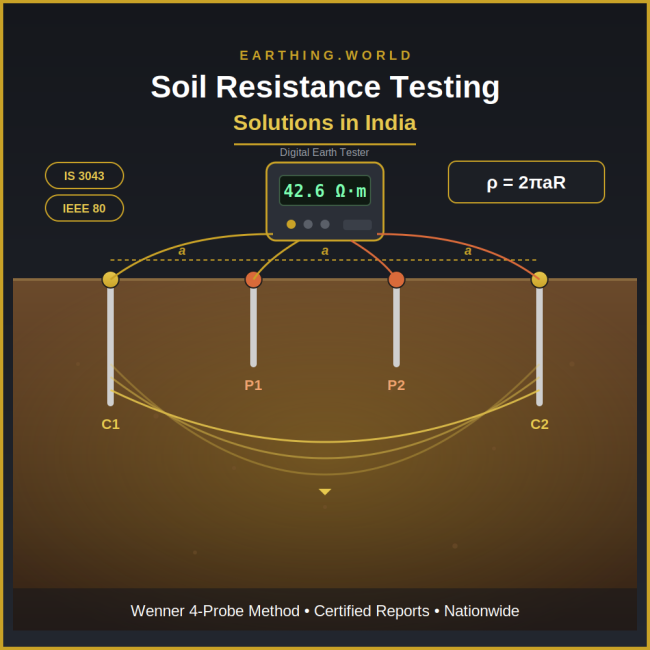
Every reliable earthing design begins with one number: how readily the ground beneath your site can carry fault current away from people and equipment. Earthing.World measures that number on-site using the Wenner four-probe method to IS 3043, IEEE 80 and IEEE 81, then hands your design engineer a clean, interpreted soil model — not just raw readings. The result is an earthing system that performs in a real fault, in every season, and passes inspection the first time.

→ Book a site survey or request a quote: calibrated instruments, certified technicians, and a report your design engineer can use the same week.

What Is Soil Resistivity Testing?

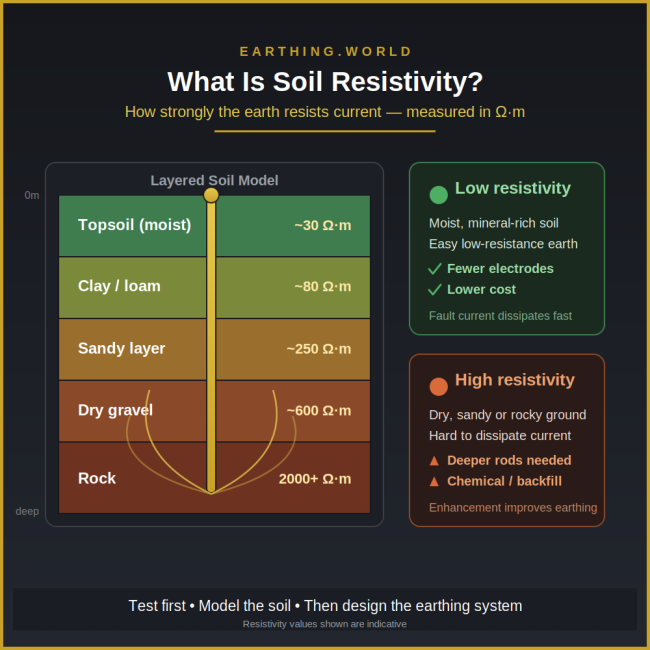
Soil resistivity testing measures how strongly the earth at a given site resists the flow of electric current, expressed in ohm-metres (Ω·m). It is the single most important data point in grounding design: it tells engineers whether the soil will dissipate a fault current in milliseconds or hold it dangerously near the surface. Because resistivity changes with depth and across a site, the test is performed at several probe spacings to build a layered “soil model” rather than relying on a single reading.

In practice, low resistivity (moist, mineral-rich soil) makes a low-resistance earth easy to achieve; high resistivity (dry, sandy or rocky ground) means more electrodes, deeper rods, or chemical / backfill enhancement are needed. Testing first — before design — is what separates a system that simply exists from one that actually protects.

Testimonial

What People Saying About Our Services

Submit Enquiry

Book an Appointment

Review an accurate quote within 3-5 days when you fill out the form on this page. Or, give us a call: (+91 72900 43400)

    Why Soil Resistivity Matters

    Without accurate resistivity data, even a well-built earthing installation can fail under real fault conditions. Reliable testing underpins three outcomes that matter on every project:

    • Rapid fault-current dissipation — fault energy is channelled safely into the ground within milliseconds, before it can damage equipment or injure people.
    • Protection of sensitive equipment — controlled ground potential rise shields transformers, switchgear, servers and instrumentation from surge and back-EMF damage.
    • Safety of human life — correctly designed earthing keeps touch and step voltages within safe limits as defined by IEEE 80, preventing electrocution near energised structures.

    It is also the difference between a design that is approved and one that is sent back: inspectors and consultants increasingly demand resistivity data and an interpreted soil model as evidence that the earthing design is engineered, not assumed.

    Why Choose Earthing.World for Soil Resistivity Testing

    Earthing is all we do. Our field teams have run resistivity surveys across substations, solar plants, factories, hospitals, data centres and critical defence infrastructure — the high-stakes sites where a poor earth is not an option. That focused experience shows up in three ways:

    • Calibrated, professional-grade instruments — we use traceable, calibrated digital earth/resistivity testers, not off-the-shelf units, so the data holds up to scrutiny.
    • Certified, experienced technicians — trained field engineers who know how to read a difficult site and isolate interference, not just take a reading.
    • Engineering-grade reporting — interpreted soil models and clear recommendations your design team can act on immediately, backed by full standards traceability.

    Industries We Serve

    Sector

    Why resistivity testing is critical

    Substations & power

    Touch/step-voltage safety to IEEE 80 demands an accurate soil model.

    Solar & renewables

    Large arrays over varied ground need site-wide resistivity mapping.

    Data centres

    Very low earth resistance is achievable only with precise soil data.

    Hospitals

    Life-safety and sensitive equipment require fail-safe earthing.

    Factories & industrial

    High fault levels and machinery earthing depend on reliable ground.

    Railways & infrastructure

    Signalling, traction and station earthing rely on accurate soil data.

    Earthing.World

    Accounting for Seasonal Variation

    Soil resistivity is not a fixed property. It rises in dry summers and falls when moisture and dissolved salts increase after rain, and it shifts with temperature and the depth of the water table. A reading taken on one wet morning can badly mislead a design if used unadjusted. We apply a seasonal variation factor (F) and, where the project warrants it, recommend the worst-case design condition — so the earthing system stays effective year-round, including the dry months when resistivity peaks and earthing is hardest to achieve.

    Soil Resistence Testing - Our Process

    Scope & site review
    We confirm project type, area, access and the standards you must meet.
    On-site Wenner survey
    Multiple traverses at increasing spacings, with perpendicular checks for interference.
    Data Analysis
    Raw readings inverted into a layered soil model with seasonal adjustment.
    Report & recommendations
    A standards-referenced report your design engineer can use immediately.
    Design support (optional)
    We can carry the soil model straight into earthing design and product selection.

    Standards & Compliance

    Our methodology and reporting are aligned to the standards your consultant and inspecting authority will check against:

    • IS 3043 — the Indian Standard Code of Practice for Earthing, including soil-resistivity measurement guidance (para 13).
    • IEEE 80 — guide for safety in AC substation grounding (touch and step voltage limits).
    • IEEE Std 81 — guide for measuring earth resistivity, ground impedance and surface potentials.
    • IS 732 & CEA Regulations — wiring and safety provisions relevant to electrical installations in India.

    For projects exporting equipment or following international practice, we can also report to ASTM G57 and IEC 62305, so the same survey serves both Indian compliance and global design teams.

    What You Receive — The Test Report

    A resistivity reading is only useful when it is interpreted. Every Earthing.World survey is delivered as an engineering document, not a spreadsheet of numbers:

    • Raw field data for every traverse and probe spacing, with site sketch and GPS-tagged test locations.
    • Calculated apparent resistivity (Ω·m) plotted against depth.
    • An interpreted one- or multi-layer soil model ready for earthing-design software.
    • Recommended earthing approach — conventional electrode, chemical/maintenance-free, or backfill-enhanced — based on the soil profile.
    • Standards-compliance statement (IS 3043 / IEEE 80 / IEEE 81) and technician sign-off.

    Frequently Asked Questions (FAQs) – Soil Resistance Earthing Testing Solution in India

    What is a good soil resistivity value for earthing?

    Lower is better — low resistivity soil dissipates fault current more easily. There is no single universal figure; the target depends on the application and the maximum allowable earth resistance for that system. What matters is matching the design to the measured resistivity profile, which is exactly what testing establishes. As a rule of thumb, moist mineral-rich soils may read well under 100 Ω·m, while dry sandy or rocky ground can exceed 1,000 Ω·m and need enhancement.

    How is soil resistivity measured?

    The industry-standard technique is the Wenner four-probe method. Four equally spaced electrodes are driven into the ground; current is injected through the outer pair and voltage measured across the inner pair. Resistivity is then calculated as ρ = 2πaR, where ‘a’ is the electrode spacing and ‘R’ the measured resistance. Increasing the spacing reads deeper soil layers.

    How often should soil resistivity be tested?

    Resistivity should be measured at the design stage of every new installation, and re-tested whenever site conditions change significantly — major earthworks, added load, or a new structure. Because soil resistivity also shifts seasonally, critical sites benefit from periodic verification, typically alongside routine earth-resistance checks.

    What standards does the test follow?

    Earthing.World follows the Wenner method as recommended by IS 3043, IEEE 80 and IEEE Std 81, with reporting also available to ASTM G57 and IEC 62305 for export and international projects.

    What is the difference between the Wenner and Schlumberger methods?

    Both use four electrodes, but they space them differently. Wenner keeps all four equally spaced and is the most widely used for grounding design because of its strong signal-to-current ratio. Schlumberger places the potential probes closer together and is occasionally used for deeper or faster surveys, but it needs more sensitive instruments. For earthing design, Wenner is the standard choice.

    How much does soil resistivity testing cost in India?

    Cost depends on site location, area, number of traverses and required turnaround. Because every project differs, we quote per site after a short scope review — contact us with your project details for an accurate figure.

    Get a Free Earthing Consultation from Earthing World

    Don’t gamble with electrical safety. Speak to Earthing World’s certified earthing experts today for a free site assessment and a customised chemical earthing solution that meets Indian safety standards.

    📞 Call Now | 📧 Request a Quote 

    Earthing World – India’s Trusted Partner in Electrical Safety & Earthing Solutions.