
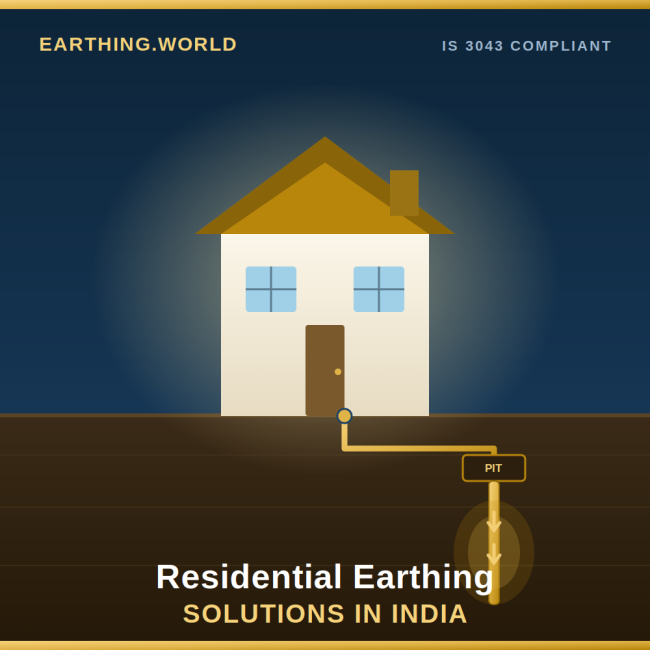
Residential Earthing Solutions: Protecting Your Home with Engineered Safety

Your home is the one place that should always feel safe — yet hidden electrical faults remain one of the most overlooked household risks. A properly engineered earthing system quietly does the most important job in your electrical setup: it gives fault current and surges a safe path into the ground, away from your family and your appliances. At Earthing.World, we design, install and certify residential earthing systems that meet IS 3043:2018, IS 732 and CEA requirements, so your home stays protected, compliant and future-ready.

Why Residential Earthing Matters

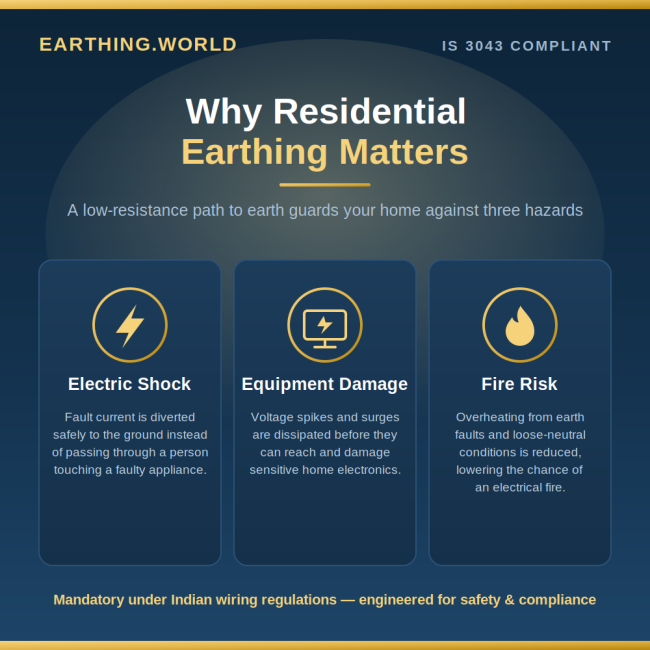
Modern homes run far more electrical load than the houses they replaced — air conditioners, inverters and UPS backups, induction cooktops, EV chargers, water heaters and a growing list of sensitive electronics. Without a low-resistance path to earth, a single insulation failure or surge can pass dangerous voltage onto metal appliance bodies, wiring and fixtures. Effective earthing protects against three distinct hazards:

  • Electric shock: fault current is diverted to ground instead of through a person touching a faulty appliance.
  • Equipment damage: voltage spikes and surges are dissipated before they reach sensitive electronics.
  • Fire risk: overheating from earth faults and loose neutral conditions is reduced, lowering the chance of an electrical fire.

Indian wiring regulations make earthing mandatory for exactly these reasons. A well-designed system also stabilises appliance performance against voltage fluctuation and extends the working life of your electrical installation.

Testimonial

What People Saying About Our Services

Submit Enquiry

Book an Appointment

Review an accurate quote within 3-5 days when you fill out the form on this page. Or, give us a call: (+91 72900 43400)

    What Makes a “Good” Earthing System for a Home?

    A residential earthing system is judged on one core number — its earth resistance. For a home, the goal is a stable, low resistance value (typically measured against the limits in IS 3043), maintained year-round regardless of soil moisture or season. Three things decide whether you achieve that: the electrode material, the soil condition, and the quality of installation. This is why the “best” earthing for one house can be the wrong choice for another — the right answer depends on your soil and your load, not on a one-size-fits-all package.

    Compliance and Peace of Mind

    Electrical safety is not only about the installation — it is about proof. Every system we deliver is designed and tested to IS 3043:2018, IS 732 and applicable CEA regulations, and you receive a measured earth-resistance test report on completion. That documentation matters for safety, for insurance and for any future property due diligence, giving you written assurance that your home is genuinely protected, not just nominally earthed.

    Earthing.World

    Advanced Materials for Long-Term Reliability

    Conventional GI-pipe earthing often struggles in India’s varied soils — it dries out, corrodes and drifts to a higher resistance within a few years. That is why we specify engineered earthing compounds such as Marconite and Duraphite for homes that need dependable, permanent grounding. Unlike salt-and-charcoal backfill, these compounds set into a compact, permanently conductive mass around the electrode and hold a low, stable resistance regardless of moisture, temperature or season. The result:
  • Low and stable earth resistance across all soil types, including rocky and sandy ground.
  • A long service life with little or no routine maintenance — no annual watering of the pit.
  • Consistent, code-compliant performance that protects sensitive electronics year after year.
  • A safe earthing system is the result of disciplined process, not just digging a pit. Every Earthing.World residential project follows the same five-step, fully documented workflow:

    Our Residential Earthing Installation Process

    Site & soil assessment
    Our engineers measure soil resistivity and inspect the existing electrical setup.
    System design & electrode selection
    We select the electrode and compound suited to your soil, load and space.
    Excavation & installation
    The electrode is installed to the correct depth and surrounded with the engineered backfill compound.
    Bonding & connection
    Conductors link the electrode to your main distribution board and metallic services.
    Testing & certification
    We verify the earth resistance with a calibrated earth tester and hand over a test report and compliance documentation.

    Earthing Options for Homes — and Where Each One Fits

    There is no single “best” earthing type; there is only the right type for your soil, space and budget. Here is how the common residential options compare.

    Earthing Type

    Best Suited For

    Trade-off

    GI pipe earthing

    Budget installs in moist, low-resistivity soil; small homes

    Shorter life; needs periodic watering and maintenance

    Plate earthing

    Standard homes where deep excavation is feasible

    Plates can corrode in acidic/alkaline soil; needs space

    Chemical earthing

    Dry, sandy or rocky soil; inverter/UPS loads; low maintenance

    Higher upfront cost; superior long-term reliability

    Engineered (Marconite / Duraphite)

    Tough soils, premium homes, lightning-prone areas, fit-and-forget

    Premium investment; lowest lifetime maintenance


    Customised Solutions for Every Home

    No two properties share the same soil, layout or electrical load, so we never quote blind. Every installation begins with an on-site assessment and a soil resistivity test, and the design is then tailored to the property type:

    • Urban apartments: compact, space-efficient electrode systems for buildings with limited open ground.
    • Independent houses: robust grounding sized to the full household load, inverter and appliance base.
    • Villas & farmhouses: multi-pit and lightning-protection-ready designs for larger, exposed layouts.

    Frequently Asked Questions (FAQs) – Residential Earthing Solutions India

    Which earthing is best for a home?

    It depends on your soil and load. Chemical or engineered-compound earthing gives the most stable, low-maintenance performance — especially in dry or rocky soil — while plate or GI-pipe earthing can suit homes in moist, low-resistivity soil on a tighter budget. A soil resistivity test confirms the right choice.

    How many earthing pits does a house need?

    A well-installed chemical earthing system from Earthing World typically lasts 10–15 years, depending on soil and climatic conditions.Most 2BHK–3BHK homes need at least two pits — one for electrical safety and one for backup or lightning protection — but the exact number depends on your load and soil condition.

    How long does a residential earthing system last?

    Conventional GI earthing often lasts only a few years before resistance rises, whereas engineered chemical earthing can hold a stable, low resistance for 15–20 years or more with minimal maintenance.

    Is earthing legally required for homes in India?

    Yes. Indian wiring rules and CEA regulations require electrical installations to be properly earthed, and systems should be designed and tested to IS 3043:2018.

    How deep is a chemical earthing pit?

    The standard depth is approximately 3 metres, with a 100 mm diameter bore and a 17.2 mm electrode.

    What Does Home Earthing Cost?

    Homeowners researching residential earthing almost always ask about price first — so it helps to understand what actually drives the cost. The final figure depends on four factors rather than a fixed rate:

    1. Electrode material: copper offers the best conductivity and life but costs more than GI; engineered compounds add to upfront cost but cut lifetime maintenance.
    2. Soil resistivity: dry or rocky soil needs deeper pits or additional electrodes to reach a safe resistance, raising material and labour.
    3. Number of earthing pits: a typical 2BHK–3BHK home needs at least two pits — one for electrical safety and one for backup or lightning protection.
    4. Installation depth & access: deeper pits (usually 2.5–3 m) and difficult site access increase the work involved.

    Rather than publish a flat rate, we give a transparent, itemised quote after the site survey — so you pay for a system sized correctly for your home, not for an over- or under-specified package.

    Why Choose Earthing.World

    • Specialised earthing expertise — earthing and grounding is our core discipline, not a side service.
    • Engineered, durable materials — Marconite and Duraphite compounds for low-maintenance, long-life performance.
    • Proven track record — a nationwide presence with installations across homes and critical infrastructure.
    • Documented, compliant work — soil testing, IS 3043 compliance and a measured test report on every job.

    Protect your home with engineered earthing

    Book a residential earthing assessment today. Our engineers will test your soil, recommend the right system for your home and give you a transparent, itemised quote — with full IS 3043-compliant documentation on completion.


    Limitations of Chemical Earthing You Should Know

    Many vendors market chemical earthing as a “maintenance-free earthing system“, but at Earthing World, we believe in transparency. Here are the real-world limitations every buyer in India should understand:

    • Rainwater Leaching: Continuous rainfall can dissolve salts in the earthing compound, causing them to leach deeper into the soil.
    • High Groundwater Levels: If the water table lies within the earthing depth, salts may wash away faster than expected.
    • Resistance Build-Up Over Time: As salts deplete, earth resistance increases, gradually reducing system performance.
    • Recharging Required: Periodic recharging or replacement of the earthing compound is necessary in many Indian climatic conditions — especially in coastal and high-rainfall regions.

    This is why expert consultation and routine inspection are essential for long-term reliability.

    Get a Free Earthing Consultation from Earthing World

    Don’t gamble with electrical safety. Speak to Earthing World’s certified earthing experts today for a free site assessment and a customised chemical earthing solution that meets Indian safety standards.

    📞 Call Now | 📧 Request a Quote | 🌐 Visit www.earthingworld.com

    Earthing World – India’s Trusted Partner in Electrical Safety & Earthing Solutions.