
Plate Earthing Solutions – Conventional & Corrosion-Free Systems

Reliable earthing protects every life and every rupee of equipment inside your facility. At Earthing.World, we design, supply and install GI and copper plate earthing systems that comply with IS 3043, IS 732 and CEA regulations — and where you need it, we upgrade you to maintenance-free, corrosion-resistant earthing that lasts for over five decades. Whichever path fits your soil and load, you get a documented, tested, compliant earth.

50+ yrsIS 3043ZeroPan-India
Engineered system lifeCEA & IS 732 compliantMaintenance upgradesSurvey → install → test report

Industries We Serve

Manufacturing plants & factories, hospitals & healthcare, data centres & IT, power & solar installations, commercial towers, defence & critical infrastructure.

What Is Plate Earthing?

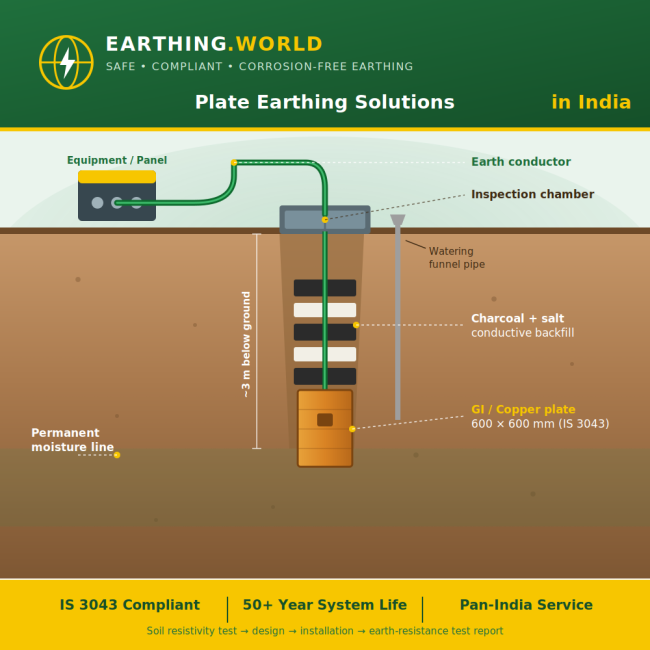
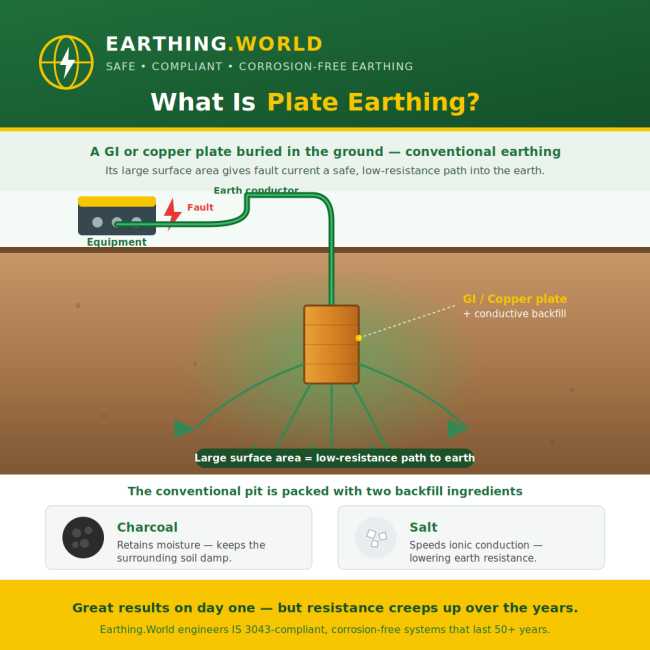
Plate earthing is one of the oldest and most widely used grounding methods in electrical engineering — often called conventional earthing. A metal plate, usually galvanised iron (GI) or copper, is buried vertically in the ground and surrounded by a conductive backfill. The plate’s large surface area gives fault currents a low-resistance path to dissipate safely into the earth, shielding people from electric shock and equipment from damage.

In a traditional pit the plate is packed with alternate layers of charcoal and salt:

  • Charcoal retains moisture and keeps the surrounding soil damp.
  • Salt accelerates ionic conduction, lowering earth resistance.

Initially this delivers excellent, low-resistance results. The challenge — as every facilities engineer eventually discovers — is what happens over the next few years.

Testimonial

What People Saying About Our Services

Submit Enquiry

Book an Appointment

Review an accurate quote within 3-5 days when you fill out the form on this page. Or, give us a call: (+91 72900 43400)

    Plate Earthing Specifications as per IS 3043

    A correctly engineered plate earthing system follows defined material, dimension and depth standards. These are the benchmarks our engineers design and verify against:

    Parameter

    Copper plate

    GI plate

    Standard plate size

    600 × 600 × 3.15 mm

    600 × 600 × 6 mm

    Larger duty option

    1.2 × 1.2 m

    1.2 × 1.2 m

    Burial

    Vertical, below permanent moisture level

    Vertical, below permanent moisture level

    Typical depth (top of plate)

    ~3 m below ground level

    ~3 m below ground level

    Backfill (conventional)

    Alternate charcoal & salt layers

    Alternate charcoal & salt layers

    Target earth resistance

    ≤ 5 Ω (domestic) / ≤ 1 Ω (industrial)

    ≤ 5 Ω (domestic) / ≤ 1 Ω (industrial)

    Pit spacing

    2 × electrode length between pits

    2 × electrode length between pits

    Earth resistance follows the IS 3043 relationship for a plate electrode — it is governed mainly by soil resistivity and plate surface area, which is exactly why a soil resistivity test should precede any design.

    We don’t just hand over products — we deliver confidence, compliance and sustainability, backed by documentation you can show any auditor or electrical inspector.

    Why Choose Earthing.World

    • Standards-first engineering. Every design is verified against IS 3043, IS 732 and CEA regulations.
    • Soil-led design. We test before we recommend — soil resistivity dictates material, size and method.
    • Lifetime value. Maintenance-free systems engineered for 50+ years, not a few monsoon seasons.
    • Environmentally responsible. Non-polluting backfills that protect soil and groundwater. • Documented & tested. You receive earth-resistance test readings and a compliance record on handover.
    The chemical earthing installation process by Earthing World follows a precise, standards-compliant methodology:

    Plate Earthing Installation Process – Our Process

    Site survey & soil resistivity test
    We measure before we design.
    System design
    method, material and electrode count selected to your fault current and soil.
    Supply & installation
    Executed to IS 3043 by trained technicians.
    Earth-resistance testing
    Measured, verified and recorded.
    Documentation & handover
    Compliance record and test report provided.

    Stop paying for earthing that corrodes. Book a free site survey and our engineers will test your soil, recommend the right plate or maintenance-free system, and give you a transparent quote with a documented compliance path.

    Plate Earthing vs Pipe Earthing vs Chemical Earthing

    Most buyers are weighing plate earthing against the alternatives. Here is the honest engineering comparison:

    Factor

    Plate earthing

    Pipe earthing

    Chemical / maintenance-free

    Electrode

    Flat GI/Cu plate

    Vertical GI/Cu pipe

    Pipe + engineered compound

    Surface area / capacity

    Large – high current capacity

    Smaller

    High & stable

    Space needed

    More excavation

    Less – compact

    Compact

    Best soil

    Good-conductivity soil

    Low-resistivity, moist soil

    All, incl. dry/rocky

    Maintenance

    Periodic (water/salt)

    Periodic

    Effectively zero

    Initial cost

    Moderate

    Low–moderate

    Higher upfront

    Typical life

    Years (corrosion-limited)

    Years

    50+ years

    There is no single “best” — the right method depends on soil resistivity, fault current, available space, criticality and budget. Our job is to recommend the one that gives you the lowest lifetime cost per ohm, not just the cheapest pit on day one.

    GI vs Copper Plate – Which Material?

    • Copper — superior conductivity and corrosion resistance, longer life; preferred for critical, high-fault-current installations.
    • Galvanised iron (GI) — zinc-coated, economical and dependable for general-purpose use in stable soils.

    Frequently Asked Questions (FAQs) – Plate Earthing Solutions in India

    What is plate earthing?

    Plate earthing buries a GI or copper plate vertically in the ground, surrounded by conductive backfill. Its large surface area dissipates fault current safely into the earth, protecting people and equipment from shock and damage.

    What is the standard plate size and pit depth as per IS 3043?

    Typically a 600×600×3.15 mm copper plate or a 600×600×6 mm GI plate, buried vertically with the plate around 3 m below ground level — ideally below the permanent moisture line.

    What is the difference between plate earthing and pipe earthing?

    Plate earthing offers a larger surface area and higher current capacity but needs more space; pipe earthing is compact and economical and often performs better in moist, low-resistivity soil. The best choice depends on soil, load and space.

    Why does conventional plate earthing need frequent maintenance?

    Charcoal and salt keep resistance low initially, but salt leaches away and the plate corrodes — the corroded layer acts as an insulator, raising resistance and forcing periodic re-charging of the pit.

    How long does a maintenance-free earthing system last?

    Systems built with engineered compounds like Marconite or Duraphite are designed for stable, low-resistance performance for over five decades with effectively zero maintenance.

    Should I choose a GI or copper plate?

    Copper gives better conductivity, corrosion resistance and life for critical installations; GI is more economical for general use. A soil resistivity test should guide the decision.

    The Hidden Cost of Conventional Plate Earthing

    We will tell you what most suppliers won’t: a charcoal-salt plate pit that looks perfect on installation day quietly degrades. Two failure modes drive this:

    1. Soil & groundwater pollution

    Salt dissolves into rainwater and groundwater over time, leaching into the earth. This both reduces the pit’s effectiveness and contaminates soil and groundwater — a real concern in India, where millions depend on groundwater for drinking.

    2. Accelerated corrosion

    Moisture, soil oxygen and heat create ideal conditions for corrosion. The plate develops a thick corroded layer that behaves as an insulator rather than a conductor. The result:

    • Earth-pit resistance rises
    • Fault-current flow is restricted
    • Frequent re-charging, maintenance or replacement is needed

    Severity scales with soil resistivity and how often water and salt are added — so the “fix” (more salt) accelerates the “problem” (corrosion and pollution).

    The Upgrade: Corrosion-Free, Maintenance-Free Earthing

    Modern engineering removes both problems. Instead of charcoal and salt, we use stable, non-polluting, corrosion-resistant compounds such as Marconite and Duraphite. Unlike conventional backfill, these engineered materials:

    • Maintain consistent conductivity year after year
    • Do not leach salt into soil or groundwater
    • Deliver dependable performance for more than five decades

    For industries, hospitals, defence establishments, data centres and other critical infrastructure, this means zero-maintenance earthing, sustained compliance with IS 3043, IS 732 and CEA norms, and genuine peace of mind.

    Note for engineers: these are maintenance-free / chemical-backfill earthing technologies. The plate-earthing electrode principle is retained where suitable; the backfill and electrode metallurgy are upgraded for longevity.

    Get a Free Earthing Consultation from Earthing World

    Don’t gamble with electrical safety. Speak to Earthing World’s certified earthing experts today for a free site assessment and a customised chemical earthing solution that meets Indian safety standards.

    📞 Call Now | 📧 Request a Quote 

    Earthing World – India’s Trusted Partner in Electrical Safety & Earthing Solutions.